

Google PageSpeed Insights Plugin for WordPress
Get real-time data directly from your WordPress Dashboard
We have Google Lighthouse integrated in our plugin and we showcase all the data related to your webpage properly in a better user interface. Our system saves your data inside your database and later you can compare your data easily. When you are done, just remove the data.
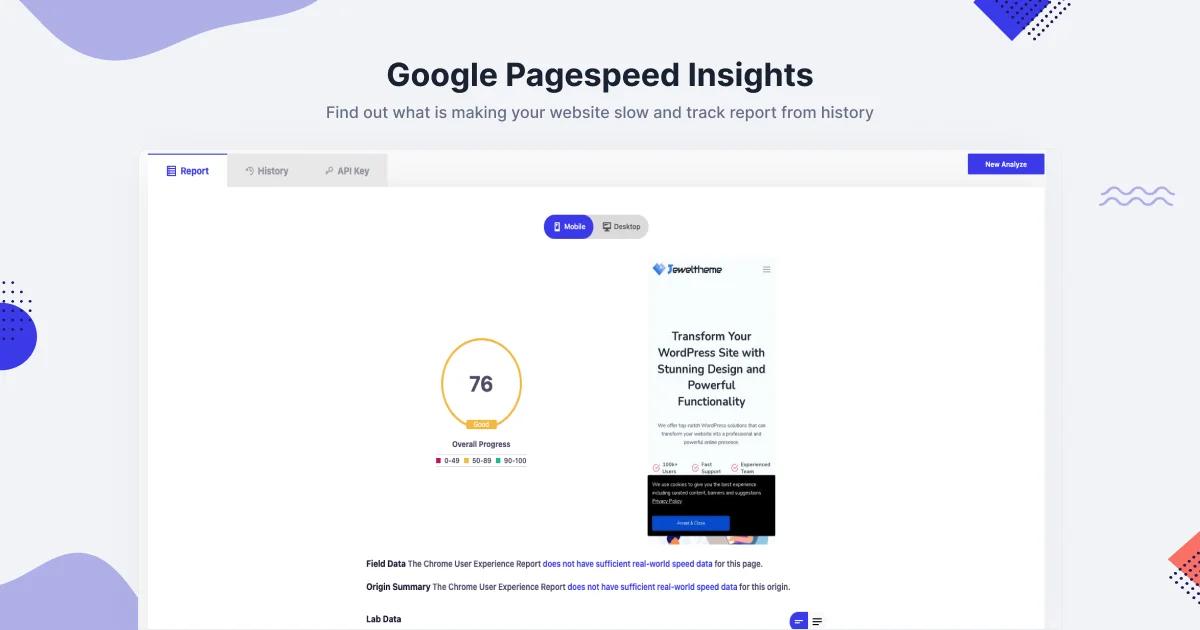
How Do You Check Google PageSpeed Insights in WordPress?
You check a page's Google PageSpeed Insights score by entering its URL at pagespeed.web.dev, or from inside WordPress with a plugin that calls the PageSpeed API. WP Adminify's Google PageSpeed addon runs the test in your dashboard, saves your mobile and desktop scores over time, and lets you analyse any URL without leaving wp-admin. Use it alongside our WordPress performance optimization guide to fix what the report flags, and see the full WordPress performance toolkit.
Benefits of the Pagespeed Insights for WordPress
Are slow web pages making it hard for you to reach your traffic goals? With the help of the Google Pagespeed Insights plugin, you can identify and solve the issues yourself. Experience a better UI and identify your pagespeed issue.
Individual report for Mobile & Desktop
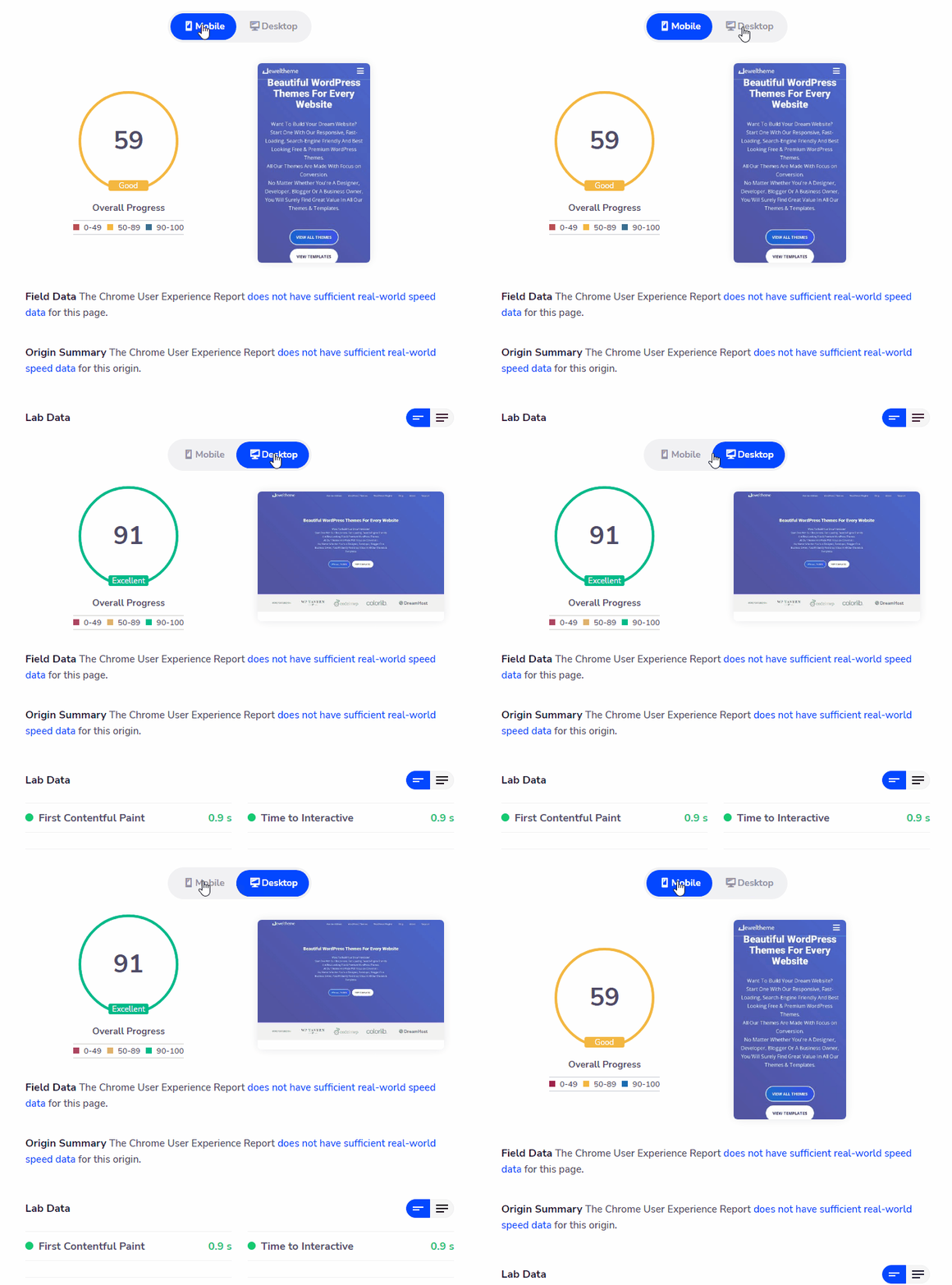
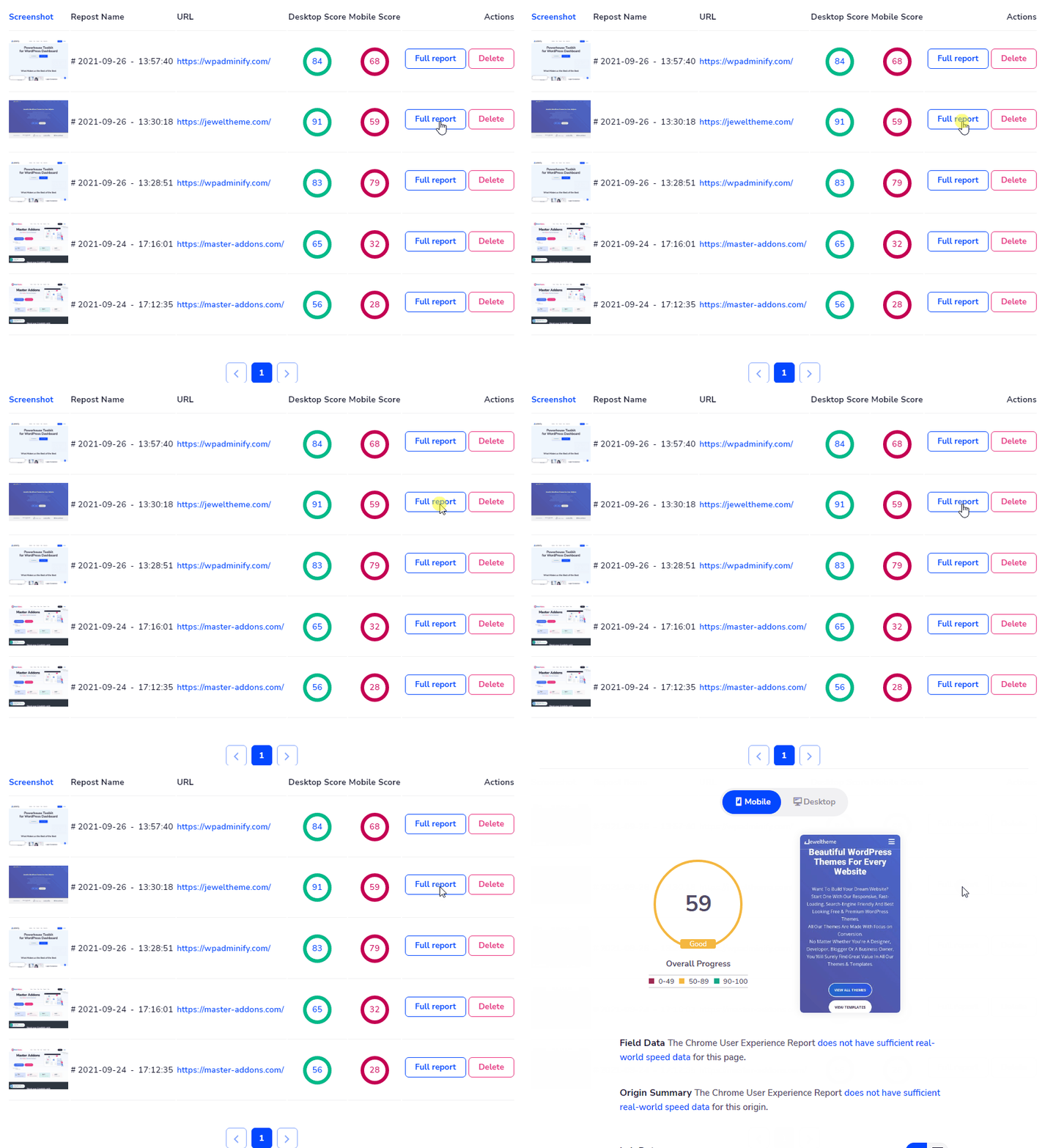
You can analyze full page-speed reports for both mobile and desktop devices. This report will be saved as history in our plugin. It’s a great advantage for you to access detailed history reports whenever you need.
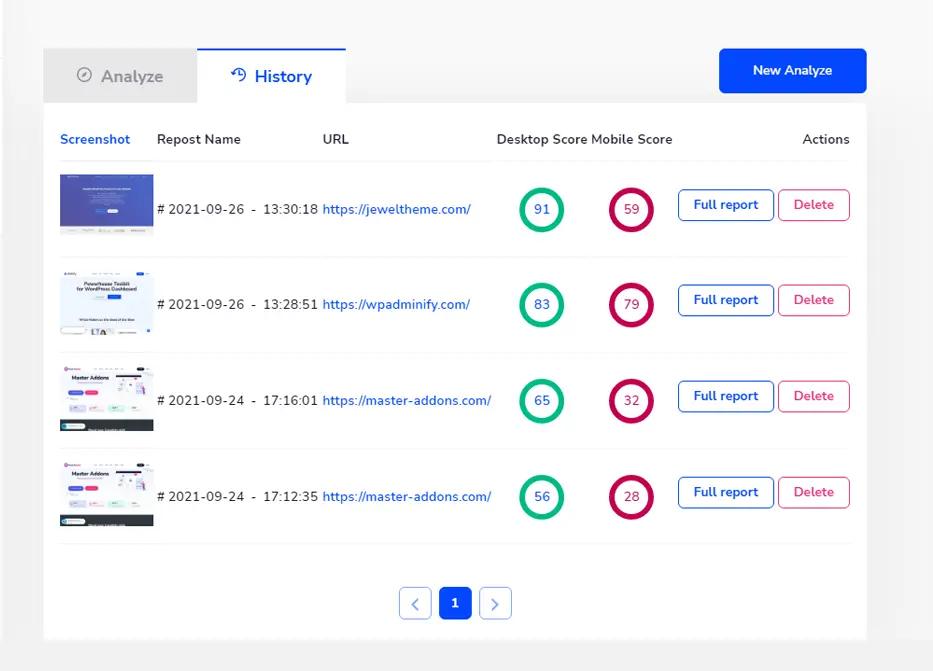
Google Pagespeed History Page
Whenever you search for any webpage speed, it will be listed on your history page. After you do some modifications to compare the present pagespeed with before, you can access the history page to check the previous page speed.
Analyze Any Webpage Speed
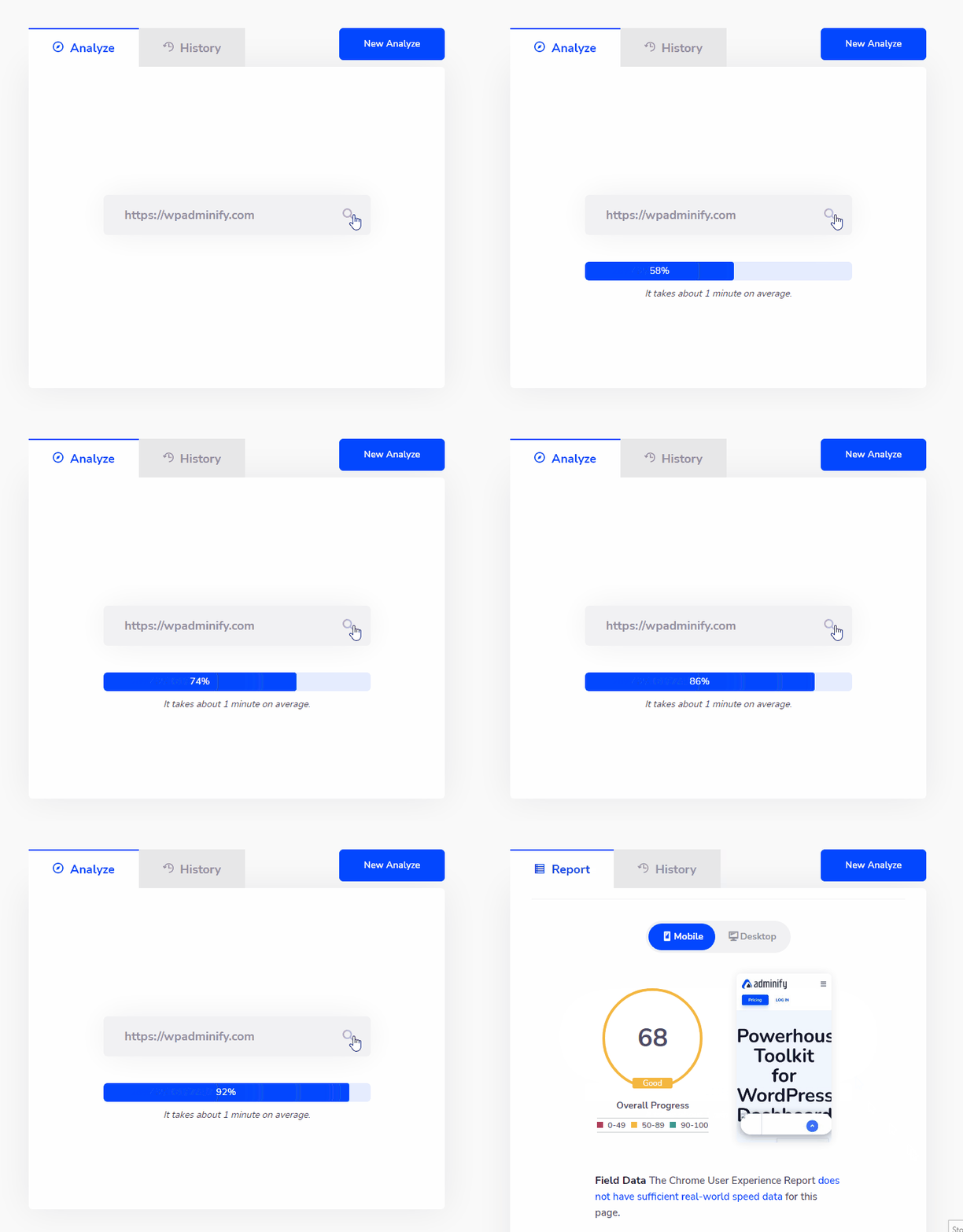
Not only your website, but you can also check any webpage's speed. You have the freedom to test data from any website. Just copy your desired page URL and paste it inside the page speed test URL field.
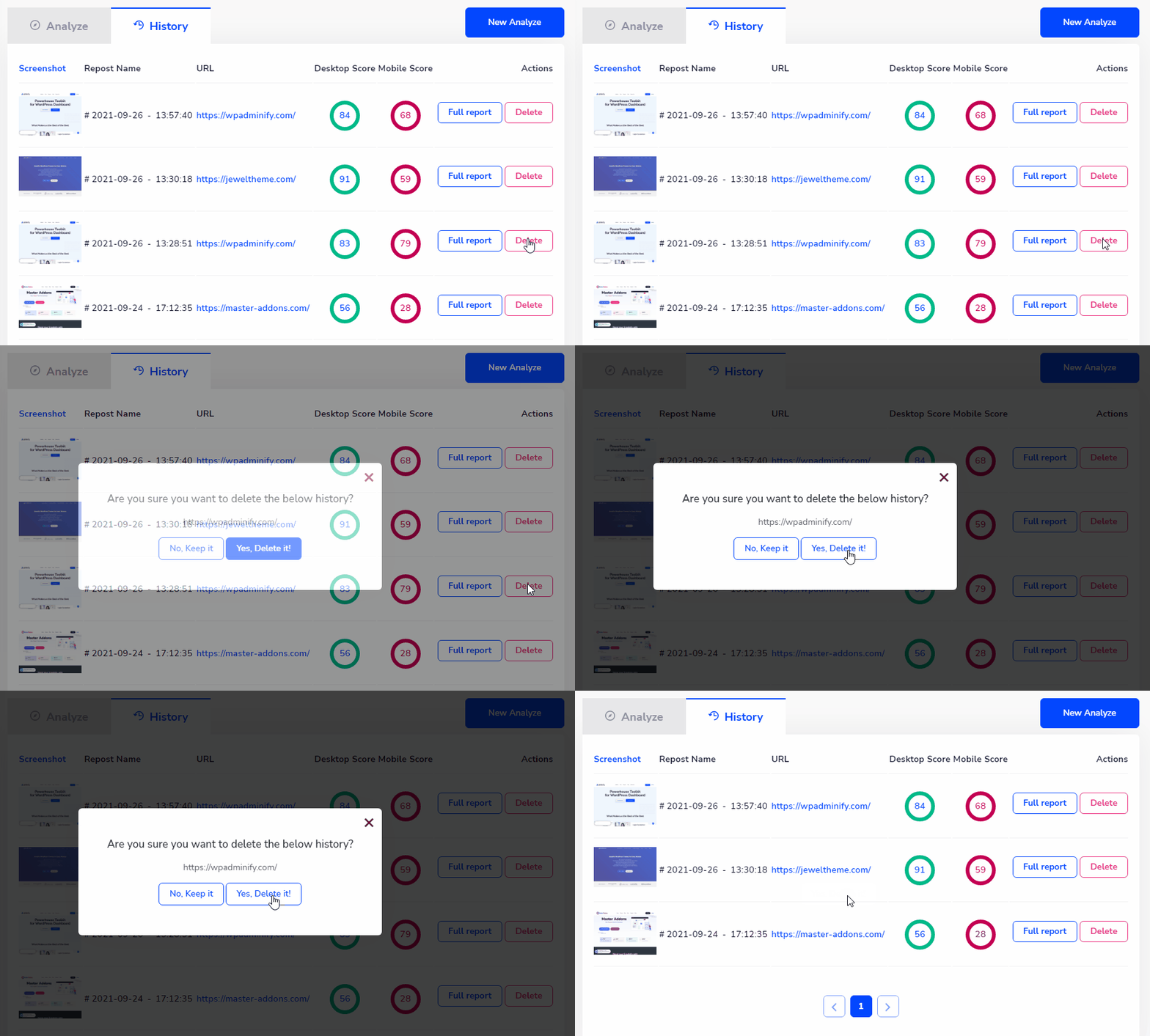
Remove Google Pagespeed history
Keeping too much history can be annoying to you. You can remove your history that you don’t need in the future. It will help you to clean your history page so that you can access your necessary page speed history easily.
Check the Report for existing saved data
If you have searched any pages, they will be stored in your history. After fixing some issues on your page, you can compare the previous speed history with the new history. It will help you to get a better idea of what’s already fixed and what needs to be fixed.

“The plugin is stable and does not affect performance, which is a significant advantage. ”

@gdimitrov
WordPress.org
"This plugin is very great: works fine, gives a very nice look to the WordPress Dashboard”

@peopleinside
WordPress.org
"This plugin lets me transform the UI, user-friendly, and fast, essential for a modern website backend."

Sascha Donelasci
Web Design Agency
“Support has been responsive and helpful, truly putting the customer first” , a rare quality these days.

Louis J Gleason
Developer & Creator
“I am totally blown away with all that WPAdminify can do! ALREADY WAY BEYOND EXPECTATIONS!!"

@shezoom
Startup
“Lot of functionalities and ability to, customize admin & login on WordPress, active support & updates.”

@Myllio
WordPress.org
What Do PageSpeed Insights Scores Actually Mean?
A PageSpeed Insights report gives you two separate verdicts. The big 0 to 100 number is a Lighthouse lab score, simulated in a controlled test. The Core Web Vitals assessment above it is field data from real Chrome visitors. A WordPress site can pass Core Web Vitals and still score 62, because the two measure different things.
Field data and lab data measure different visits
Field data comes from the Chrome User Experience Report, a rolling 28 day sample of real visits to your site, scored at the 75th percentile so one fast visitor cannot hide a slow experience for everyone else. Lab data comes from a single Lighthouse run on Google's hardware. That is why the two disagree so often: the lab run is one simulated visit on a throttled connection, while the field data is thousands of real ones on real phones and real networks. Trust the field data for how your WordPress site actually performs, and use the lab score as the diagnostic that tells you what to fix.
The three Core Web Vitals Google grades
Largest Contentful Paint (LCP) measures how long the main content takes to appear, and Google wants it under 2.5 seconds. Interaction to Next Paint (INP) measures how quickly the page responds to a click or tap, with a 200 millisecond threshold. Cumulative Layout Shift (CLS) measures how much the layout jumps while loading, and should stay under 0.1. On WordPress, LCP is usually the hero image or a slider, INP is usually heavy JavaScript from plugins, and CLS is usually ads, embeds, or a web font swapping in late.
What counts as a good score
90 to 100 is green, 50 to 89 is orange, and anything under 50 is red. Mobile scores are always lower because Lighthouse throttles CPU and network to imitate a mid tier Android phone on a slow 4G connection. A realistic target for a content heavy WordPress site is 90 or above on desktop and 50 or above on mobile, with all three Core Web Vitals passing. Chasing a perfect 100 on mobile usually costs more than the ranking benefit is worth.
What PageSpeed Insights Flags Most Often on WordPress Sites
The same handful of audits come back on almost every WordPress install, and each one traces to a familiar cause. Reading the report against the list below turns a wall of warnings into a short queue of actual work. Our WordPress performance optimization guide covers each fix in depth.
Render blocking resources and unused CSS or JavaScript
Every active plugin queues its own stylesheet and script, and page builders load their full asset bundle on pages that use none of it. Lighthouse counts those bytes twice, once as render blocking and once as unused. Deferring non critical scripts, loading CSS only where a plugin is actually used, and removing the emoji, embed, and block library assets a site never touches will move the score more than any other single change.
A slow server response time
Time to First Byte sits ahead of everything else in the waterfall, so a slow host caps your score no matter what you optimise on the front end. Shared hosting without page caching, an oversized options table with heavy autoloaded data, and uncached admin AJAX traffic are the usual culprits. If the admin side feels slow too, the reasons a WordPress admin gets slow overlap heavily with the reasons the front end does.
Images that hold back LCP
The largest element on most WordPress pages is an image, so image handling decides LCP. Serve WebP or AVIF, size the file to the container rather than uploading a 4000 pixel original, preload the hero image, and make sure lazy loading is switched off for anything above the fold. Lazy loading the LCP image is one of the most common self inflicted score problems on WordPress.
Track the number after each fix, not just before
Any of these changes can help on one template and do nothing on another, which is why a single score is worth so little on its own. Running the test from inside the dashboard and keeping the result means you can compare this week against last week per page. The page speed history view stores each run against the post it came from.
Why run PageSpeed Insights inside WordPress?
Google's own tool at pagespeed.web.dev tests one URL at a time and remembers nothing. You paste a link, read a score, fix something, paste the link again, and the earlier score is gone. That is fine once. It is useless when you are trying to answer the only question that matters after an optimisation pass: did this actually help, or did it just feel faster?
Running the same Lighthouse test from inside the dashboard changes two things. Every result is stored against the post or page it came from, so you get a history rather than a snapshot, and you can test any page from the list you are already looking at instead of copying URLs into another tab. Scores still come from Google, so the numbers match what you would see on their site.
Google PageSpeed Insights for WordPress - FAQs
How do I check my WordPress PageSpeed Insights score?
Enter your page URL at pagespeed.web.dev, or run the test from inside WordPress. WP Adminify's Google PageSpeed addon fetches the score for both mobile and desktop directly in your dashboard, so you can check any page without leaving wp-admin, and it keeps a history so you can track progress.
How do I get a Google PageSpeed Insights API key?
Create a free key in the Google Cloud console: enable the PageSpeed Insights API, then generate an API key under Credentials. The step by step API key setup walks through it with the screens, including restricting the key so it cannot be reused elsewhere. WP Adminify's PageSpeed addon uses that key to pull scores, and a key also raises the request quota so bulk or repeated checks are not rate-limited.
What is a good PageSpeed Insights score for WordPress?
90 to 100 is good (green), 50 to 89 needs improvement, and below 50 is poor. Mobile scores run lower than desktop because Google throttles CPU and network for the mobile test, so a realistic WordPress target is 90+ on desktop and 50+ on mobile.
Does WP Adminify improve my PageSpeed score?
Indirectly. The PageSpeed addon measures and tracks your score, while WP Adminify's performance tools, meaning Heartbeat control and disabling emojis, embeds, and unused Gutenberg assets, cut admin and front-end overhead that drags the score down. Pair it with caching and image optimization for the biggest gains.
Why are my mobile and desktop PageSpeed scores so different?
Lighthouse throttles the mobile test. It simulates a mid tier Android phone on slow 4G, about 1.6 Mbps with 150 ms latency and a throttled CPU, while desktop runs unthrottled on a wired line. That gap is why a mobile score in the 50s can still be healthy. Lab data is one simulated run; field data is the 75th percentile of real Chrome visits.
How does Google use PageSpeed Insights for ranking?
The 0 to 100 score is not a ranking factor. Core Web Vitals are, as part of the page experience signals, and they are measured from field data rather than from the Lighthouse score. Speed acts as a tiebreaker between pages of similar relevance, so it rarely outranks better content, but it does decide close calls and it affects how many visitors stay.
Should I ignore my PageSpeed Insights score?
Ignore the single number, not the report. The score compresses six weighted metrics into one figure that swings between runs on the same unchanged page. The audit list underneath it is stable and specific, and the Core Web Vitals assessment is what Google actually uses. Track the vitals and the audits over time, and treat the headline score as a rough progress marker.
Get Started with WP Adminify Today
We offer the best WordPress Dashboard Customization and maintenance feature to our users.
Rebrand the admin panel of personal or clients Dashboard within minutes.