
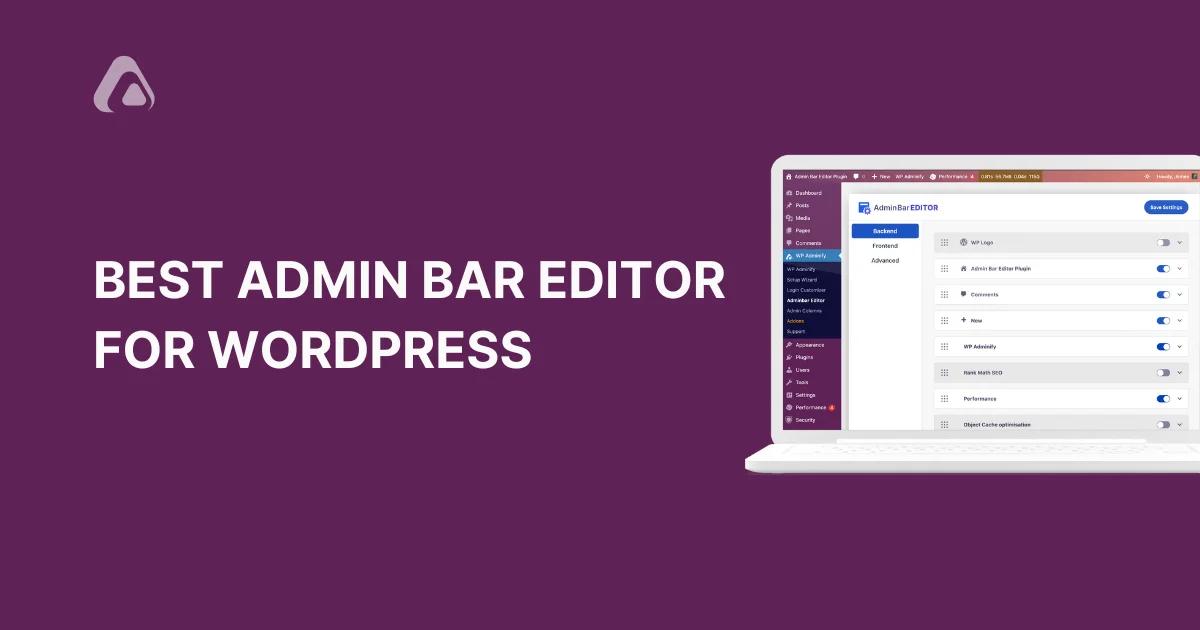

The Admin Bar in WordPress offers the most necessary options from different plugins. By default, it offers howdy text with your nickname, a New button, a Comment icon, Site name, and getting-started documentation.
When plugin installation grows over time, we notice our admin toolbar is also flooded with a lot of items.
Then we feel the necessity to create a personalized Admin Bar? I recommend, not waiting till then to start admin bar customization. Because Smart people learn from their mistakes and Wise people learn from others mistakes. Here, the WordPress Toolbar Editor will solve your every problem regarding admin bar.
Without wasting your valuable time, let me share a screenshot with you. Can you relate the issue to yourself?
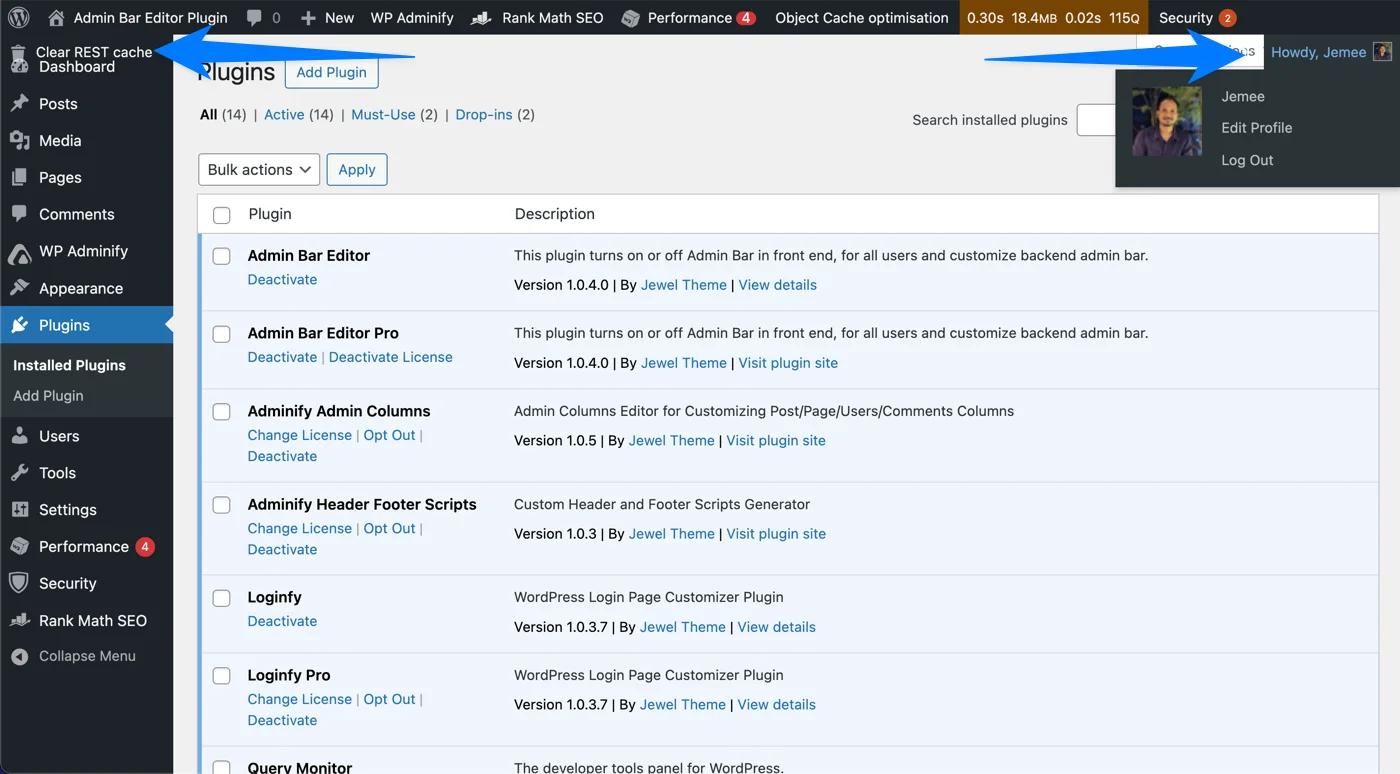
This is a messy screenshot with some admin bar items, and I have only installed 14 necessary plugins. You can see how the howdy text took position under the main admin bar pointed with the right side arrow. The Clear Rest Cache item took position before the dashboard menu item pointed with the left side arrow.
If you are a developer and work for your client's site, then I am pretty sure you don’t want to deliver a project like this to your clients.
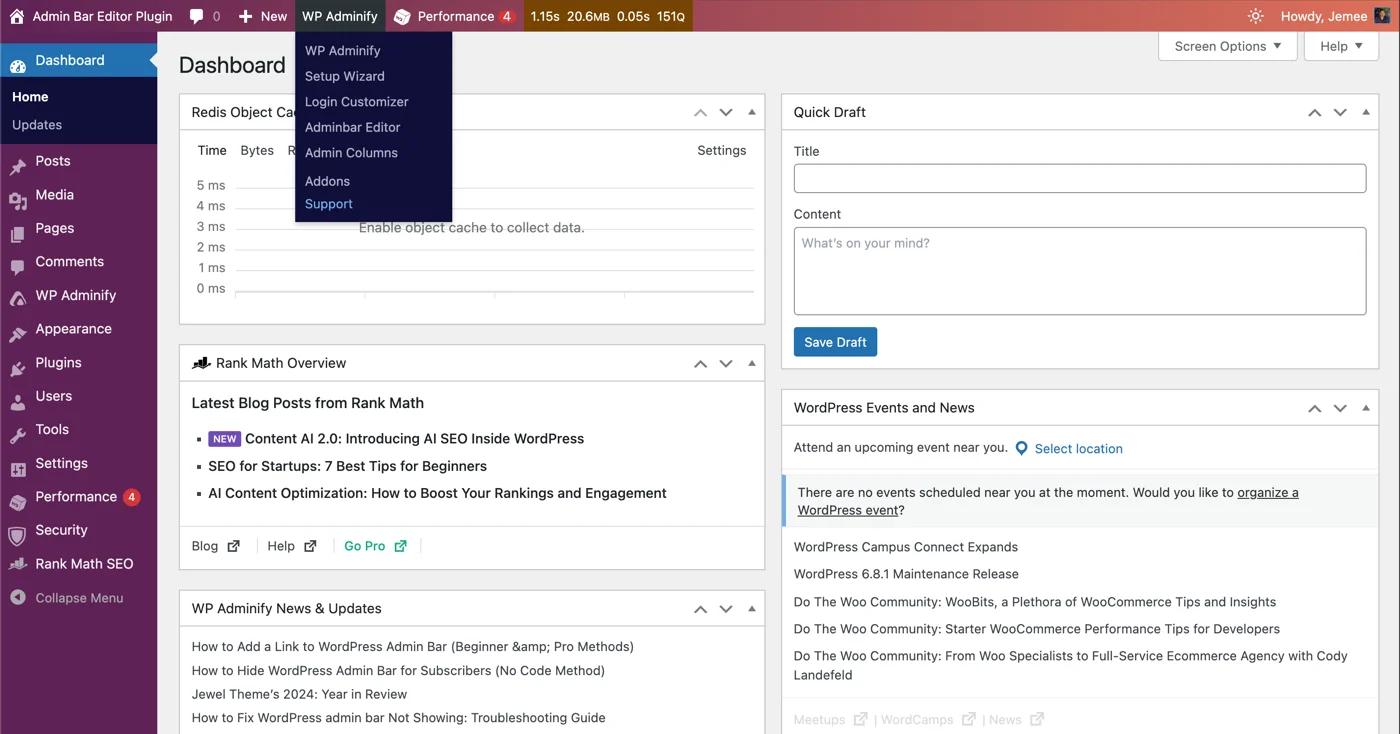
At the end of this blog post, you will be able to create a personalized WordPress admin bar for your clients like the following screenshot, with limited accessibility.
What is the WordPress admin bar?
The WordPress admin bar, also called the toolbar, is the dark strip across the top of the screen that only logged-in users see. It shows up in two places: inside wp-admin, and on the front end of your site while you browse it. Core puts a handful of shortcuts there, including the site name, a New button for creating content, the comment count, update notices, and the Howdy account menu on the right.
Core only adds those first few. Everything after that arrives on its own, because any plugin can hook admin_bar_menu and drop in an entry without asking. That is how a site running a cache plugin, an SEO plugin and a page builder ends up with a toolbar that wraps onto a second line. The only control core offers is a per-user checkbox under Users > Profile that hides the bar on the front end. Everything past that needs a WordPress toolbar editor, which is a settings screen that lists every registered admin bar item and lets you hide it, rename it, reorder it or point it somewhere else, per user role. That is what the rest of this guide walks through.
How Do You Customize the WordPress Admin Bar?
To customize the WordPress admin bar, open WP Adminify → Admin Bar Editor and drag, hide, reorder, or restrict toolbar items by user role - no code required. Prefer code? Use the admin_bar_menu hook with remove_node() to remove items, or show_admin_bar(false) to hide the bar for specific roles.
Toolbar work rarely stands alone. Agencies handing a site over usually strip the toolbar, then hide the comments menu and rebrand the rest of the admin under white label, so the client never sees a plugin name they did not buy.
Getting started with WordPress toolbar editor
Before diving, let me share the proper plan with you for customizing the WordPress Toolbar. I have tried my best to find out all possible ways that will help you to customize WordPress admin bar. But still, I may have missed something. Please feel free to comment, and I will try to provide a solution and also update the blog post.
WordPress Admin bar not showing: This is a common issue for WordPress beginners. I will explain a possible issue that can hide the WordPress Admin bar.
Hide WordPress Admin Bar: I will guide you on how to hide admin bar items for a specific user, user role.
Hide Front end Admin Bar: Instead of hiding front end admin bar from the profile page, I will show you the way to hide front end toolbar dynamically for any user or user role.
Add a link to WordPress Admin Bar: Learn how easily you can create a custom link or menu item in the Admin bar. You can create submenu items for custom links or any existing items from the 3rd level.
Disable Admin bar except Administrator: In this section, you will get the guidelines on how to disable WordPress admin bar for all users except administrators.
Define Admin Bar location: It’s not necessary to keep the Admin bar position always on top, but you can define the Admin bar position to the bottom too.
Style customization for Admin Bar: Adding a color or gradient to the Admin bar background can provide an extra personalized feel to your Admin Bar. Plus you can change the text and new button colors that match your brand.
I am going to use the Admin Bar Editor plugin and will share the necessary code snippet for the developers. Make sure to download the plugin and install it in your WordPress Dashboard.
Free Download | Admin Bar Editor PRO
WordPress Admin bar not showing
You wake up from bed and visit your website and notice the admin bar is missing, though you have logged into your dashboard. This is a common issue for beginner WordPress users.
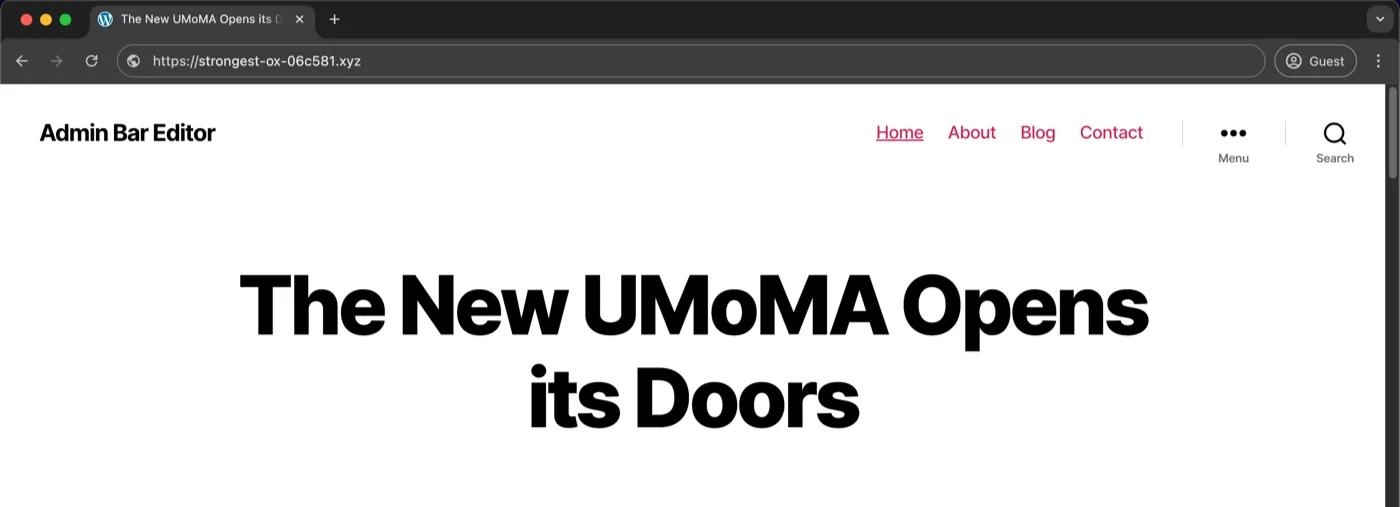
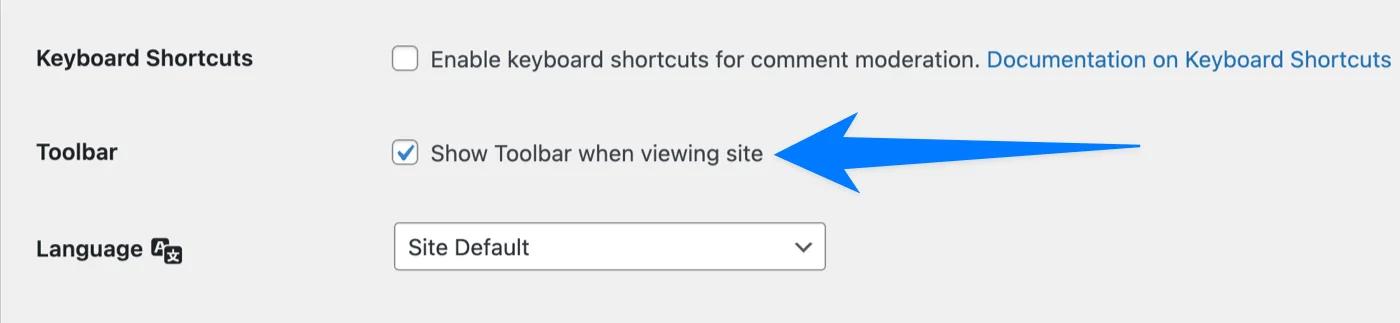
First of all, navigate to WP Admin > Profile. Now, check if "Show Toolbar when viewing site "option is checked or not. If it’s unchecked, then check this setting and save. You should preview the admin bar in the front end now.
Hide WordPress Admin Bar
There are four ways to hide the WordPress admin bar. Each user can untick Show Toolbar when viewing site under Users > Profile. A toolbar editor hides the bar, or single items in it, per role. The show_admin_bar filter switches it off in code. The admin_bar_menu hook removes one item at a time.
| Method | What it removes | Who it applies to | Code needed |
|---|---|---|---|
| Users > Profile checkbox | The front end bar only | One user, set by that user | No |
| Admin Bar Editor visibility rules | The whole bar, or single items | Any role or named user | No |
show_admin_bar filter | The whole bar, front end and back | Everyone, or a role you test for | Yes |
admin_bar_menu and remove_node() | One named item, such as the logo | Everyone the hook runs for | Yes |
Pick the profile checkbox when one person wants a clean front end. Pick the toolbar editor when the rule has to hold for a role, which is the usual case on a client site. Drop to code only when the rule belongs in version control. If you want to remove one entry rather than the whole strip, see how to remove the WordPress logo from the admin bar, and for a per-role rule read hide the admin bar based on user roles. The hide some admin bar items doc lists every toggle.
The code route is two lines. Drop this in your theme's functions.php or a snippet plugin to hide the admin bar for everyone who cannot manage options, which leaves it in place for administrators.
add_action( 'after_setup_theme', function () {
    if ( ! current_user_can( 'manage_options' ) ) {
        show_admin_bar( false );
    }
} );
Do you like to hide specific Admin bar items, or the entire Admin bar? Have you ever wanted to hide some of the admin bar items for a specific user role or user name?
All of my mentioned questions have a solution in the following guideline. Navigate to your WordPress Dashboard and click on the Admin bar Editor option. (Make sure you have installed the admin bar editor plugin.)
Note: You can notice the Admin bar editor option inside the WP Adminify menu. It’s because I have installed the WP Adminify plugin on my local server. WP Adminify and Admin Bar Editor are both 100% compatible with each other. Using both plugins can help you create a fully customized WordPress client Dashboard.
Hide backend Admin bar for specific user
Inside the Admin bar editor option, you can see the "Backend", "Frontend", and "Advanced" options. By default, the "backend" is selected.
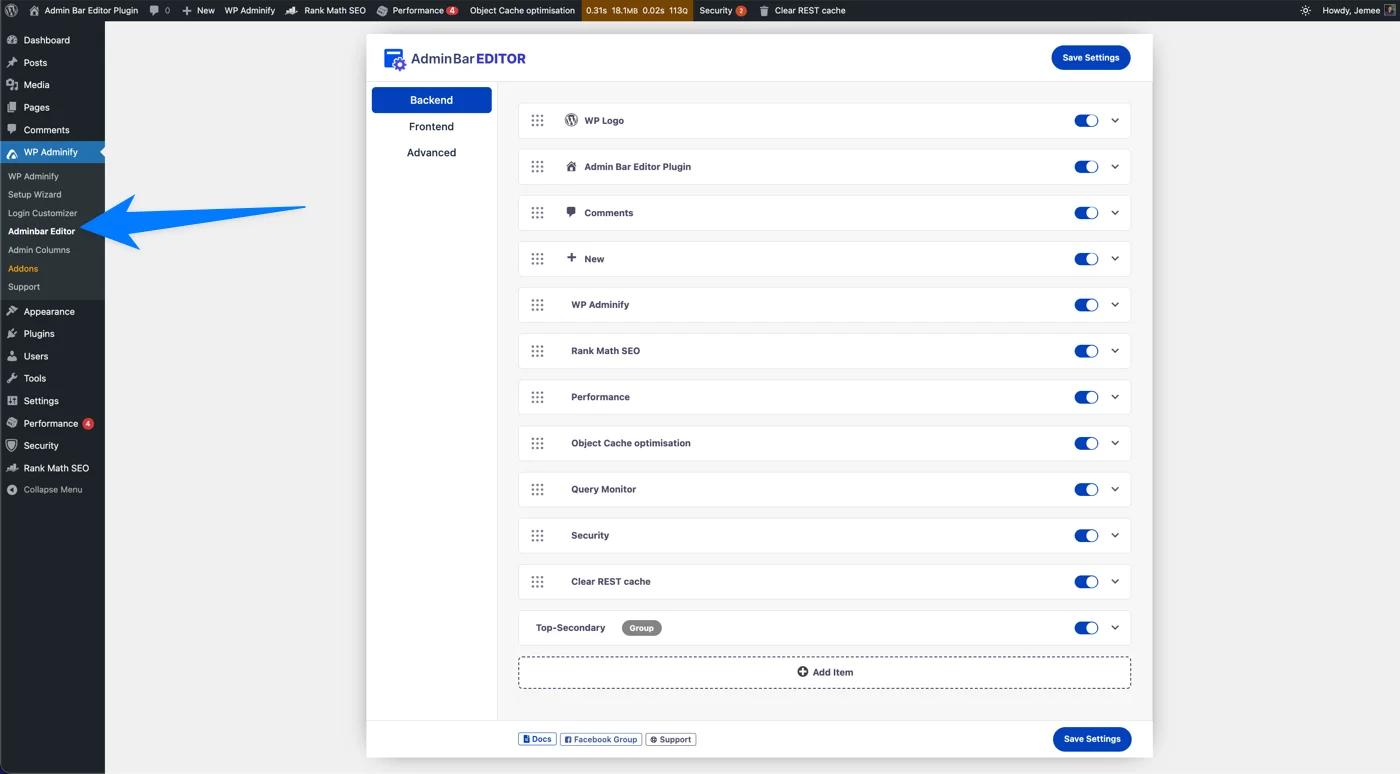
Let’s assume that we would like to hide the "Rank Math SEO" from another administrator. (I have installed Rank Math and created an admin account called "admin-client")
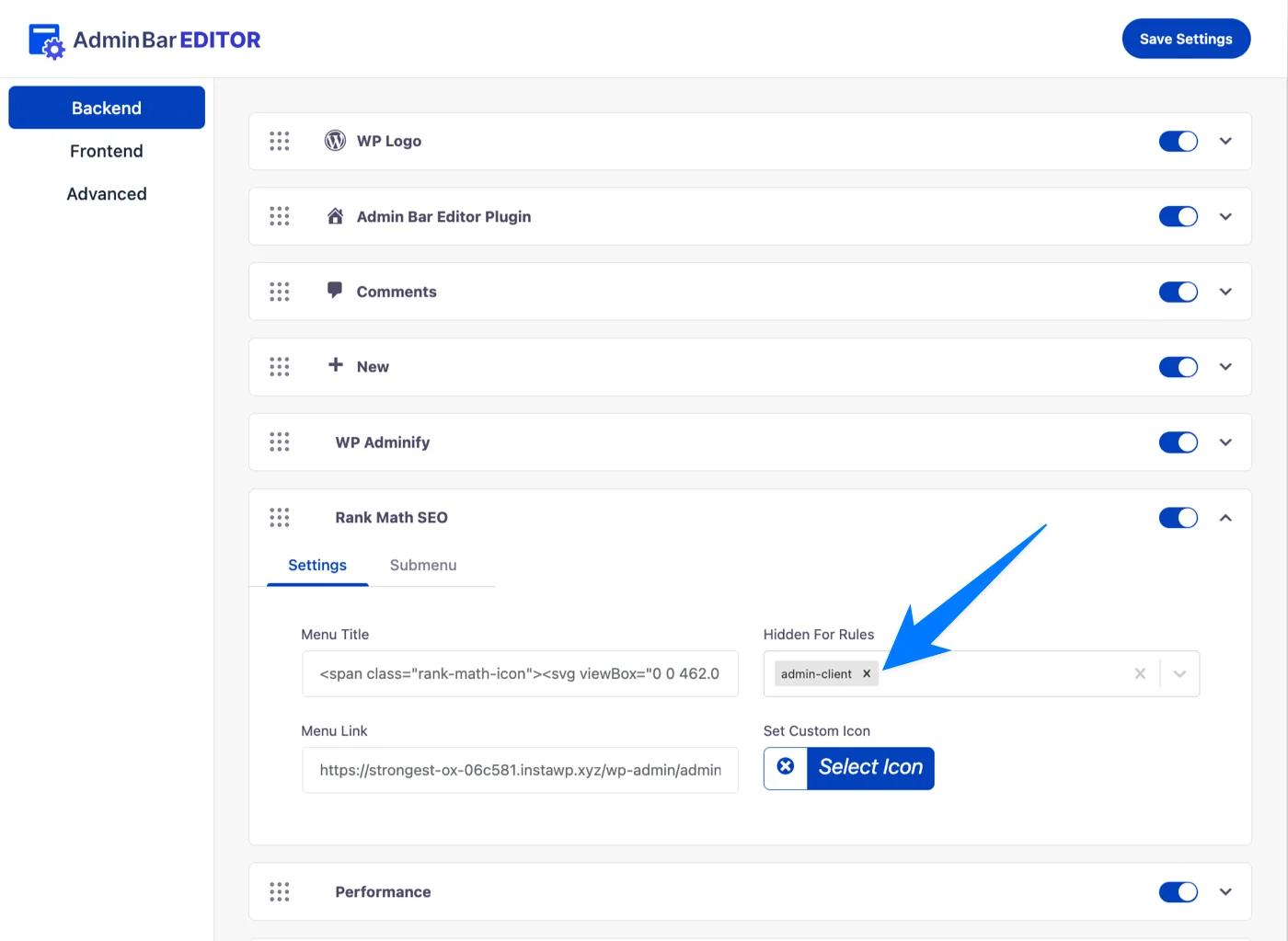
Now click on the Rank Math SEO item and it will expand some options called "Menu title", "Menu link", "Hidden for rules", and "Set custom icon". You have to click on "hidden for rules" and select the username. For me, I will select "admin-client" user name.
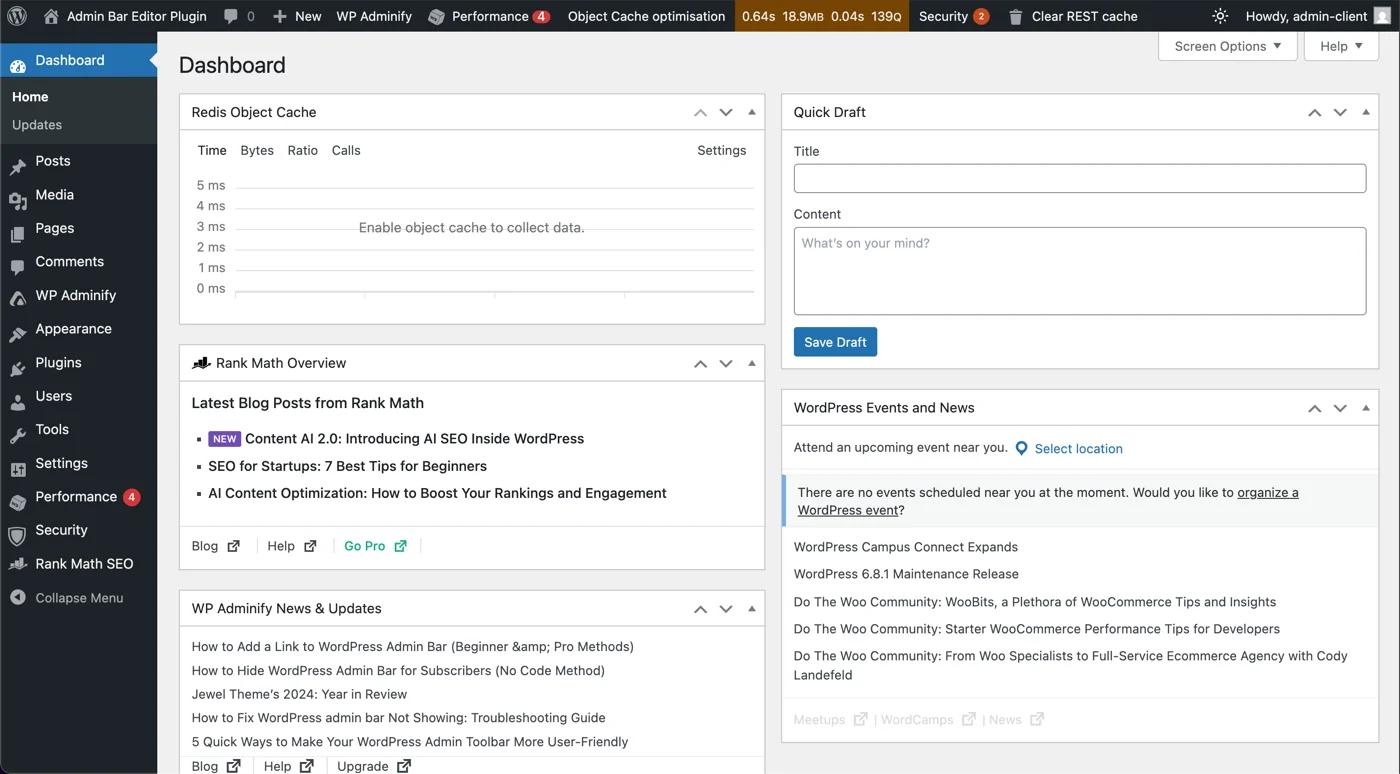
After saving the settings, try to log in with your selected admin username and password. You will notice the admin menu item is hidden from the backend. Here is a screenshot from my "admin-client" dashboard.
Hide the admin bar for all users
Hiding admin bar items is very simple, you can see an "on/off switcher" beside each admin bar item. Just toggle the switch off for which item you like to hide for all users. I have hidden a lot of items for all users in the following screenshot, and you can see the admin bar gets a cleaner view.
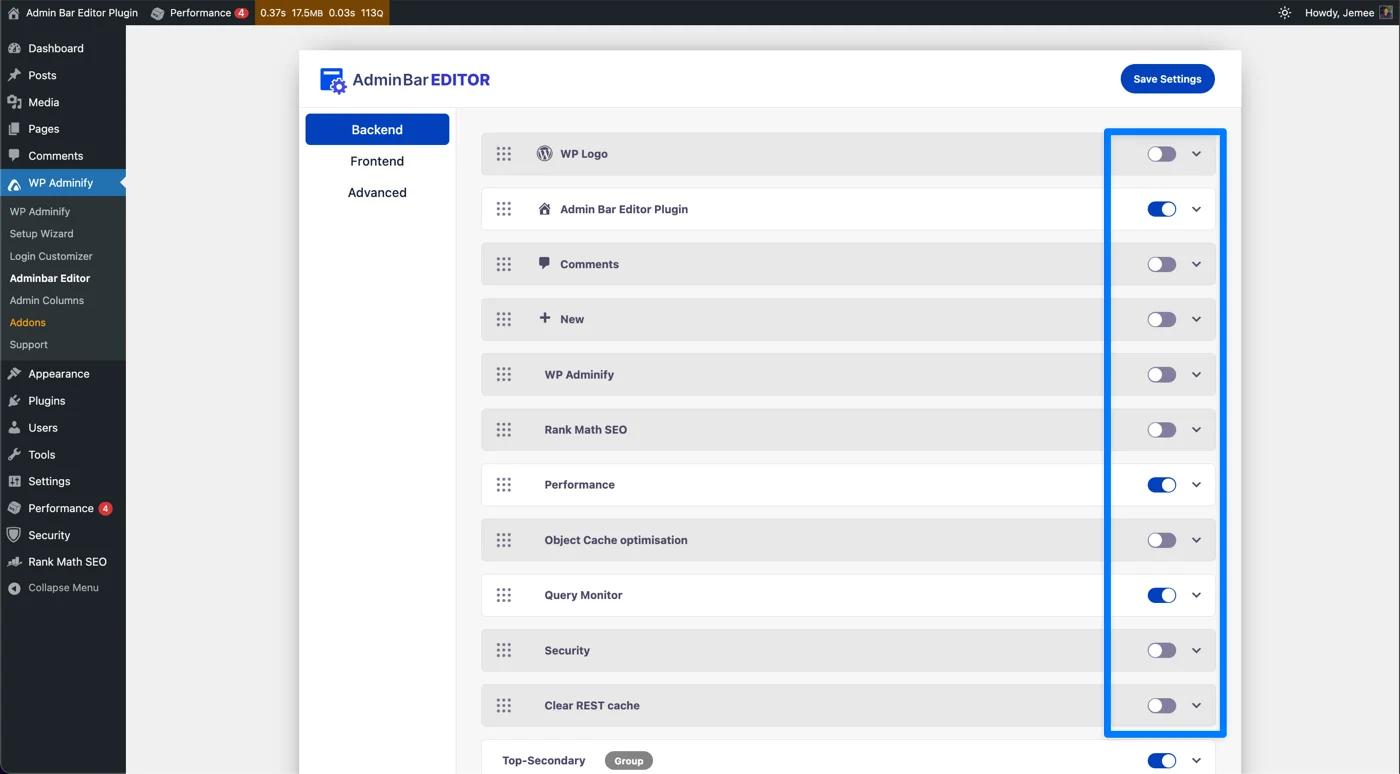
Also, you can hide your existing admin menu items for a specific user with the help of the Admin Menu editor by the WP Adminify free plugin.
Hide Front end Admin Bar
Like the backend, you can control whether you want to hide the frontend admin bar for all users or like to limit the frontend admin bar items for specific user roles or user names.
Hide the front end Admin bar for all users
Click on the Frontend option, then make the switcher "yes" from "no" for "Disable Frontend Admin Bar?". Now you can see another "yes/no switcher" for "Hide Admin Bar for All Users". Make it yes, too, then save the settings.
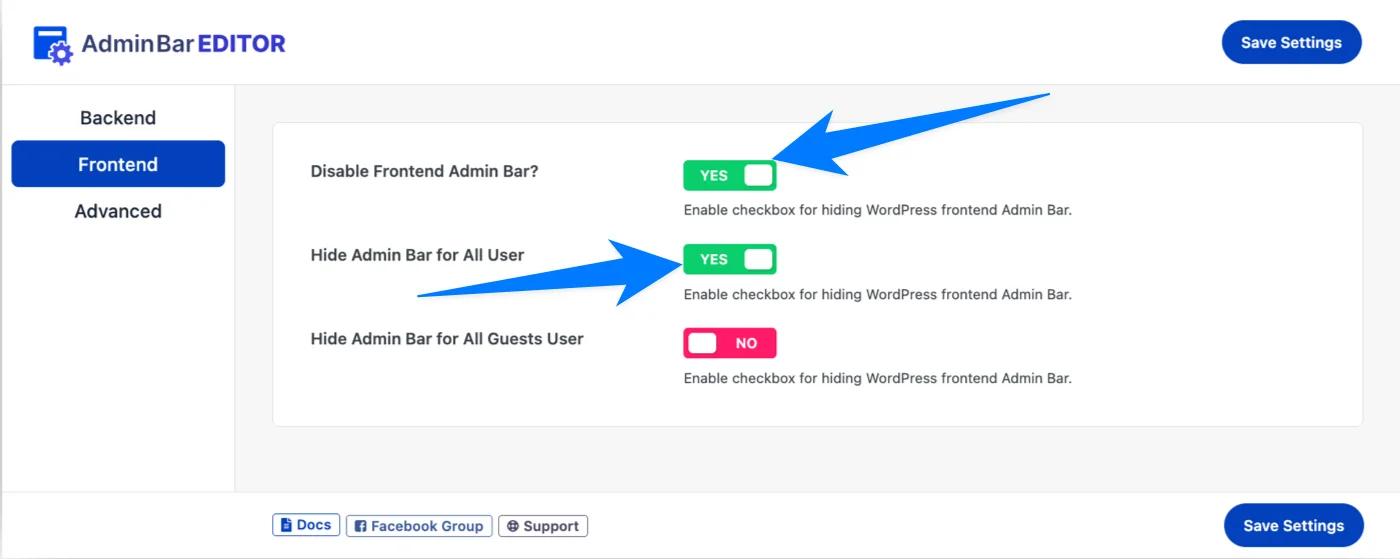
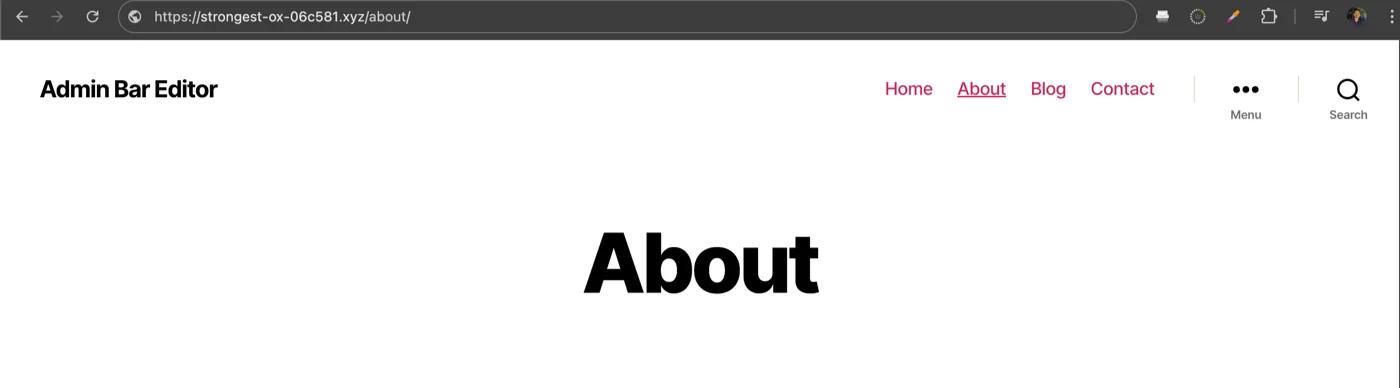
Now visit your website frontend, and you will notice the Admin bar is hidden. Now the admin bar is hidden for all users, no matter he/she is logged in as administrator or editor, or subscriber.
Add a link to WordPress Admin Bar
Adding a custom item or link to WordPress admin bar provides better control over your users. There are different types of use cases for different agencies. But I am going to explain this feature from an editorial perspective.
If you run a WordPress blog site and have multiple editors, then you can create some custom links for -
Quick Access to Posts: You can put a categorized post list inside the admin bar.
Media Library Shortcut: Maybe you manage an external service for media uploading where your designer upload media files, like Google Drive. You can link the drive folder or anything directly to the admin bar.
Custom Shortcodes & Templates: If there are any shortcodes & templates for CTA or layout, then you can put the necessary links directly to the admin toolbar.
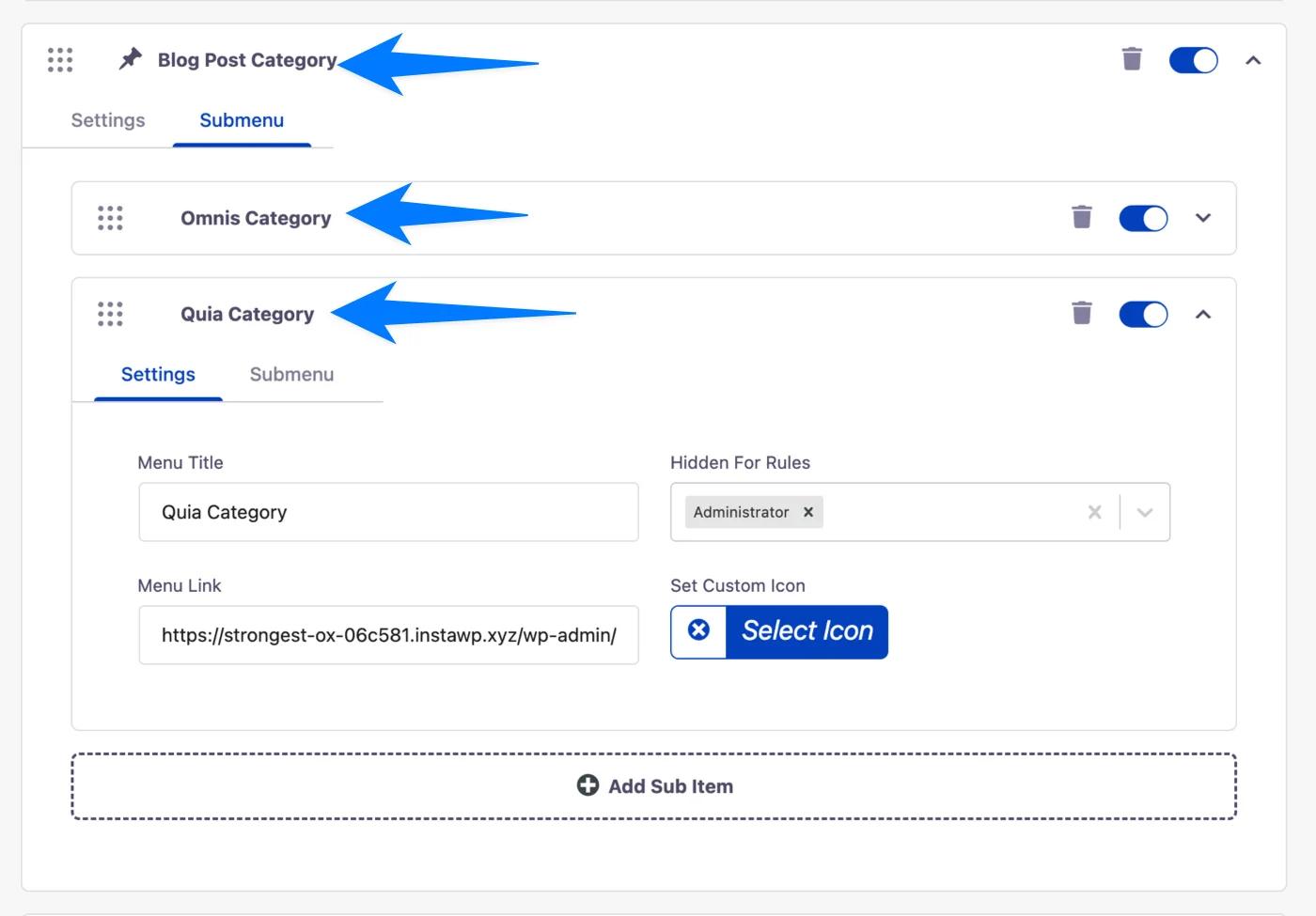
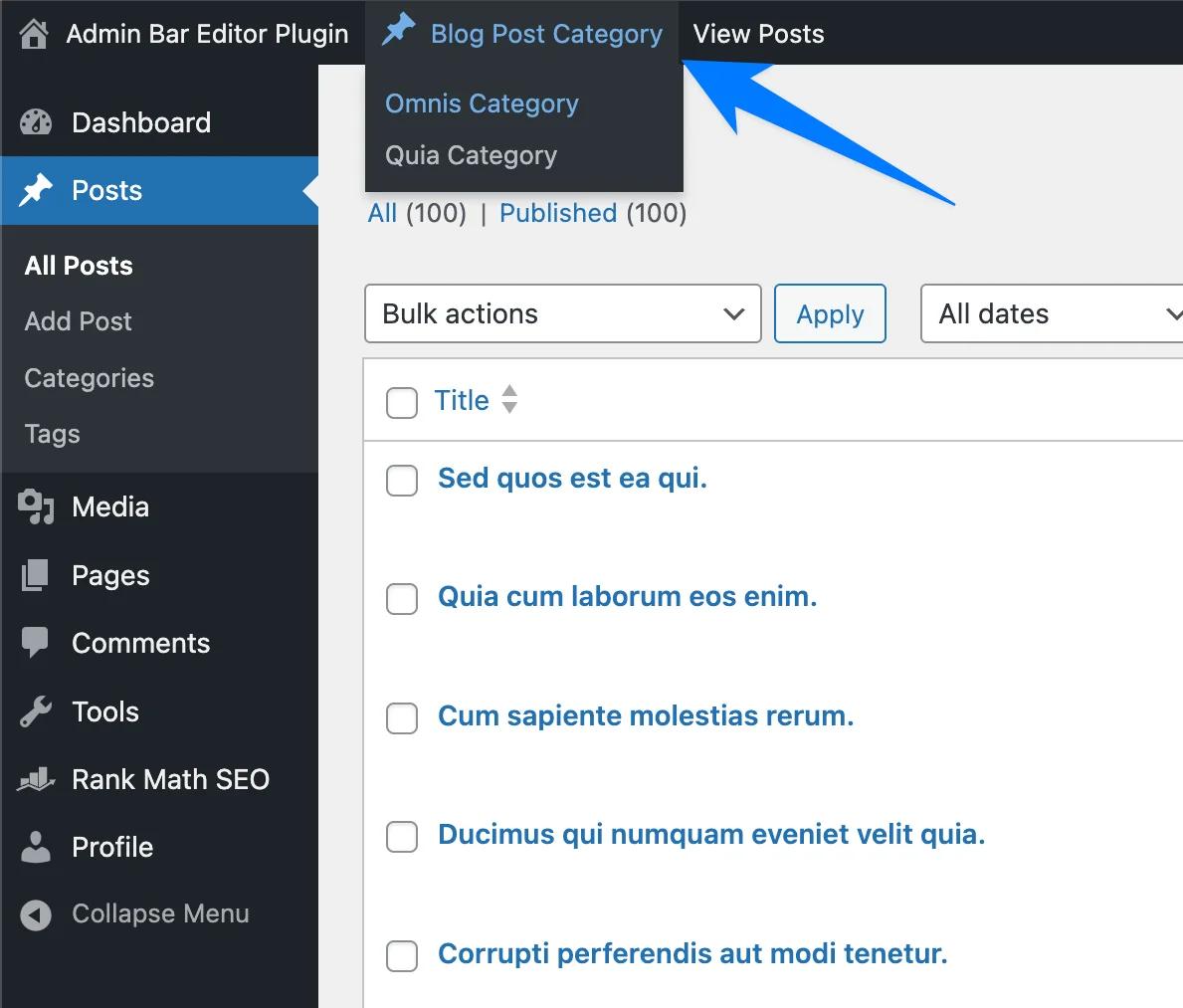
To add a link, navigate to the Admin Bar Editor. Scroll down and click on "Add Item" button. This will be your primary item. Under this primary item, you can create sub-menu items just like I did in the following screenshot. I named "Blog Post Category" as the primary item and added 2 category items as sub-items.
Take a look at the following screenshot. This is the output of my previous settings. You can create sub-menu items under a sub-menu.
Disable Admin bar except Administrator
To disable WordPress admin bar for all users except administrators, you need to create a conditional display on the frontend option.
Turn on the Yes/No switch for "Disable Frontend Admin Bar?" option. Now take a look at the last option called "Disabled For", and besides this option, there is a button called "Add new conditions". Click on this button and select all user roles except the Administrator user role.
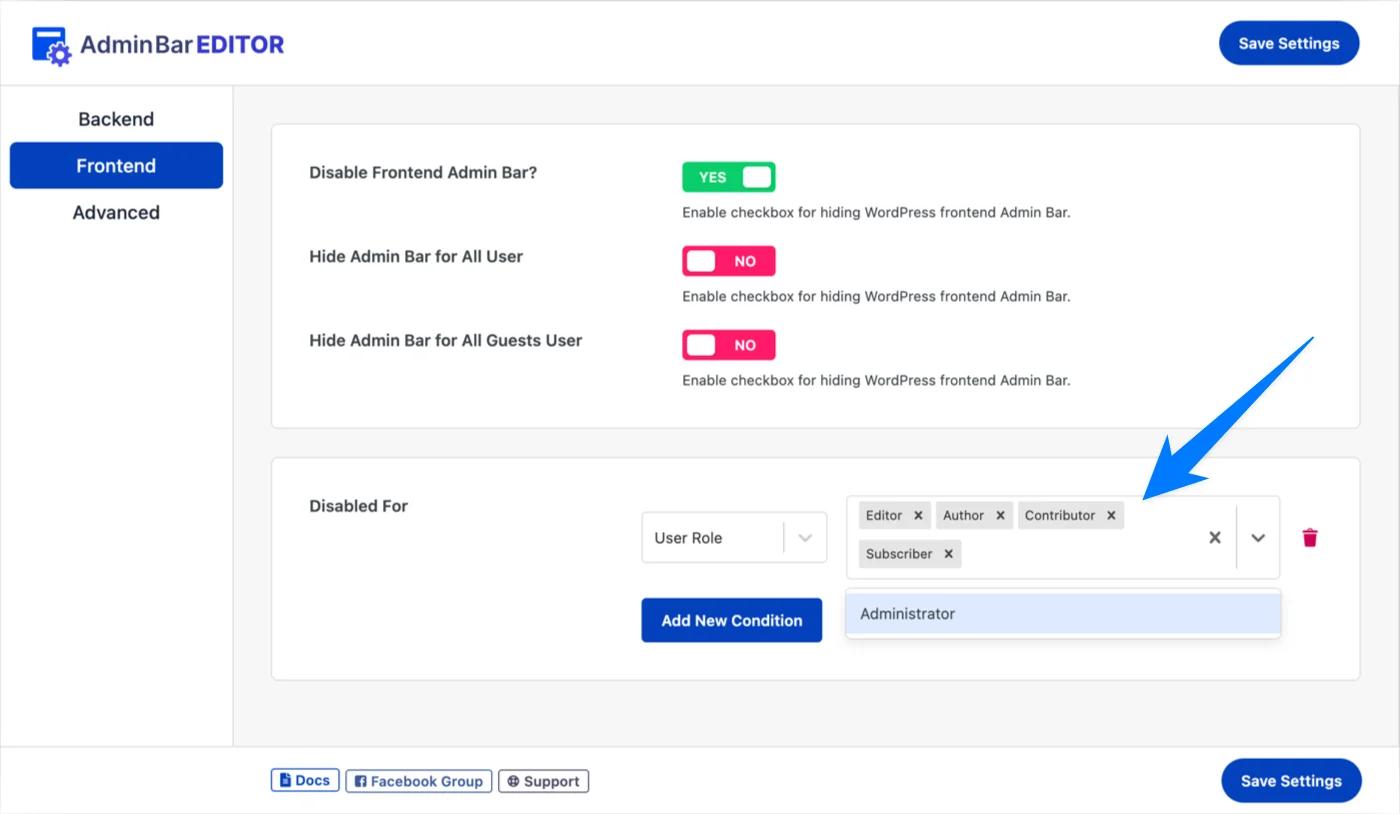
Then save the settings, and now the admin bar is disabled for all users except administrators.
Define Admin Bar location
Navigate to Admin Bar Editor > Advanced option. The first option is "Adminbar Position" which is selected by default. You can define whether you like to keep your admin bar at the top or the bottom.
Style customization for Admin Bar
Inside this advanced option, there is a tab called "Styles". Just click on this style option, and you will get all color customization options for your Admin bar background and text. I have added a gradient color as the admin bar background and changed the font color and background hover color.
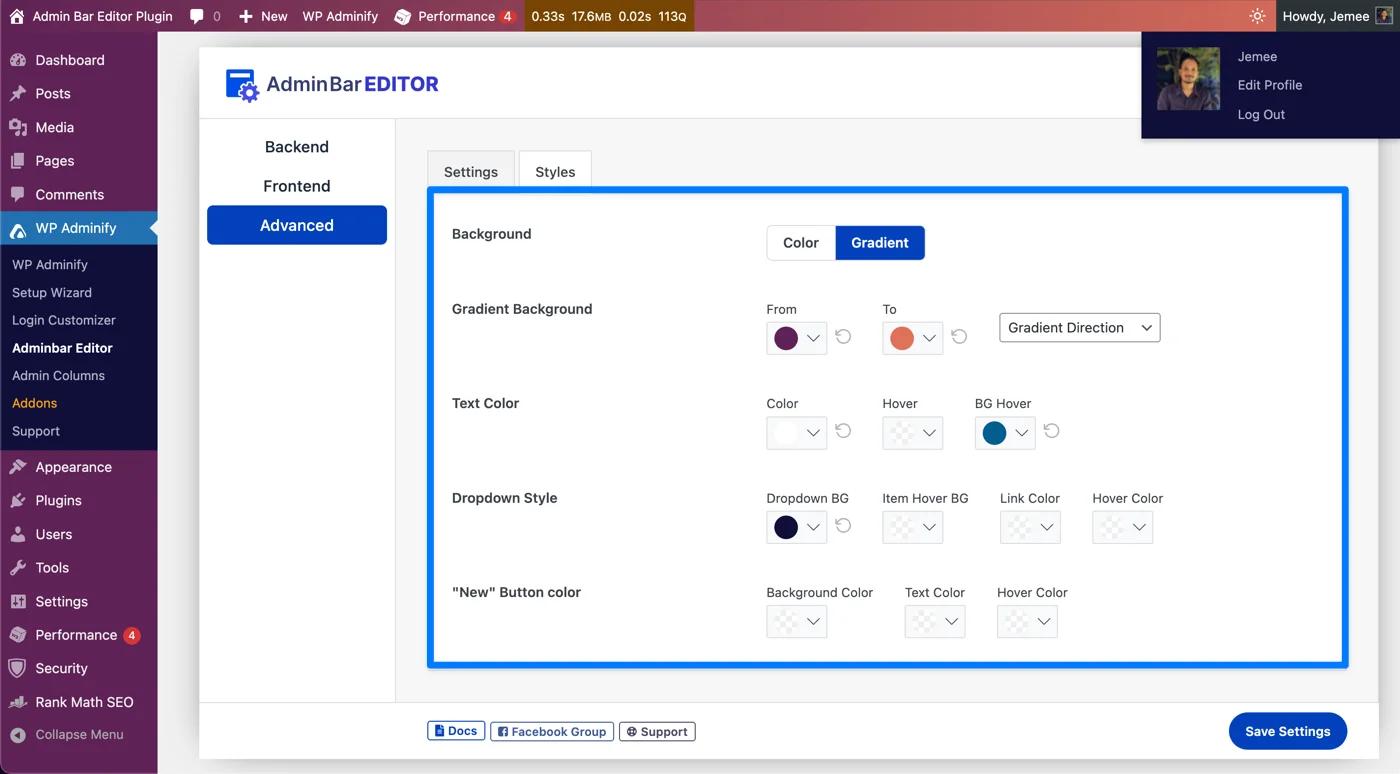
Let me clarify that changing the admin bar colors will not affect the admin menu background color. I have used the Admin Menu editor to customize the admin menu's background and text colors.
What is the difference between the admin bar and the admin menu?
The admin bar is the horizontal strip along the top. The admin menu is the vertical sidebar down the left. They sit next to each other and get talked about together, but they are separate systems with separate editors. The admin bar follows you out onto the front end of the site; the admin menu only exists inside wp-admin.
They are styled separately too, which catches people out halfway through a branding job. Recolouring the toolbar does nothing to the sidebar, and changing the sidebar leaves the toolbar exactly as it was. To make a dashboard look deliberate you set both, then the login screen, then the widgets. Our WordPress dashboard customization page walks through that order, and the admin menu editor covers the sidebar half.
WordPress Admin Bar FAQs
How do I hide the WordPress admin bar for all users except administrators?
Go to WP Adminify → Admin Bar Editor and open the visibility rules, then set the toolbar to appear only for the Administrator role. Editors, authors, and subscribers then load the site with no admin bar. Prefer code? Wrap show_admin_bar(false) in a check like if (!current_user_can('manage_options')) inside functions.php.
Can I hide the WordPress admin bar for specific user roles?
Yes. WP Adminify's Admin Bar Editor lets you toggle the toolbar per user role, so you can hide it for subscribers or customers while keeping it for your team. You can also hide individual items - like the New button or Comments icon - for chosen roles instead of removing the whole bar. It's built into WP Adminify.
How do I add a custom link to the WordPress admin bar?
Open WP Adminify → Admin Bar Editor, click Add New Item, then enter a title, URL, and an optional parent item to build a dropdown. The link appears instantly in the toolbar for the roles you choose - useful for pointing clients to support, docs, or a dashboard without editing functions.php.
How do I hide the admin bar on the frontend of my site?
To hide the toolbar only on the front end while keeping it inside wp-admin, use the front-end visibility toggle in WP Adminify's Admin Bar Editor. Manually, each user can also uncheck 'Show Toolbar when viewing site' under Users → Profile, which hides the bar for that person on the live site.
How do I remove items from the WordPress admin bar?
In WP Adminify → Admin Bar Editor, switch off any item you don't need - Howdy text, the WordPress logo, Comments, or plugin entries - with a single toggle. For a code approach, hook into admin_bar_menu and call $wp_admin_bar->remove_node('item-id') to strip specific nodes by their ID.
Why is the WordPress admin bar not showing?
The admin bar usually disappears when 'Show Toolbar when viewing site' is unchecked in your profile, your theme is missing the wp_footer() call, or a plugin disabled it. Re-enable it under Users → Profile, confirm your theme outputs wp_footer(), or manage visibility centrally in our WordPress dashboard customization toolkit.
How do I customize the WordPress admin bar?
Open WP Adminify then Admin Bar Editor and drag, hide, reorder, or restrict toolbar items by user role - no code needed. Prefer code? Hook admin_bar_menu and call add_node() to add your own items or remove_node() to strip the default logo, comments, and New buttons in functions.php.
How do I remove the WordPress admin bar programmatically?
Add show_admin_bar( false ) inside an after_setup_theme action in functions.php or a snippet plugin. Wrap it in a capability check such as if ( ! current_user_can( 'manage_options' ) ) so administrators keep the bar. To strip one entry instead, hook admin_bar_menu and call remove_node() with that item's ID.
Where is the Show Toolbar when viewing site setting?
It sits under Users then Profile, in the Toolbar row near the top of your own profile screen. Unticking it hides the admin bar on the front end for that one account only, and it has no effect inside wp-admin. Each user sets it for themselves, so it does not work as a site-wide rule.
Let’s Wrap UP!
I hope you got a clear idea on how you can control your WordPress Admin bar for specific users instead of showing it for all users. Still, if there is something that I have missed, please comment below. I will try to provide you solution and will update the Admin Bar Editor plugin for you.
The Toolbar Is Just the Top Layer
Once the admin bar looks right, the rest of wp-admin deserves the same treatment. The complete guide to customizing the WordPress dashboard covers menus, widgets, fonts, dark mode and login page customization in one place.
Your email address will not be published