


Is your WordPress admin area feeling a little bland? Or perhaps you want to streamline the interface for your clients by hiding distracting elements? Customizing the WordPress dashboard with CSS is a powerful way to improve both your workflow and the client experience.
While the front-end of your site gets all the themes and designers, the admin dashboard often gets left behind. But what if you could change colors, hide unused menu items, or even add custom branding?
In this blog post, we’ll explore every possible method to inject custom CSS into your WordPress admin area - from quick and simple to advanced and powerful. We’ll also share must-have CSS snippets you can use today and show you how to add custom JavaScript for even more control, all without touching a single line of code in your theme files.
Why Customize Your WordPress Admin Dashboard?
Before we dive into the "how," let's talk about the "why." Adding custom admin CSS allows you to:
Improve User Experience (UX): Simplify the dashboard for clients by hiding complex features they don't need.
Enhance Branding: Add your agency's logo or use brand colors to create a white-labeled experience.
Increase Productivity: Highlight or color-code important administrative elements to navigate faster.
Add Personal Flair: Make your own workspace more enjoyable with a unique look.
Method 1: Using the WP Adminify Plugin (The Easiest & Safest Way)
For most users, especially freelancers and agencies managing multiple client sites, a dedicated plugin is the best choice. It’s safe, easy to reverse, and doesn't require any code editing. WP Adminify is a powerhouse for WordPress admin customization, and it includes a perfect feature for this exact task: Admin Scripts.
How to do it:
- Install and activate the WP Adminify plugin.
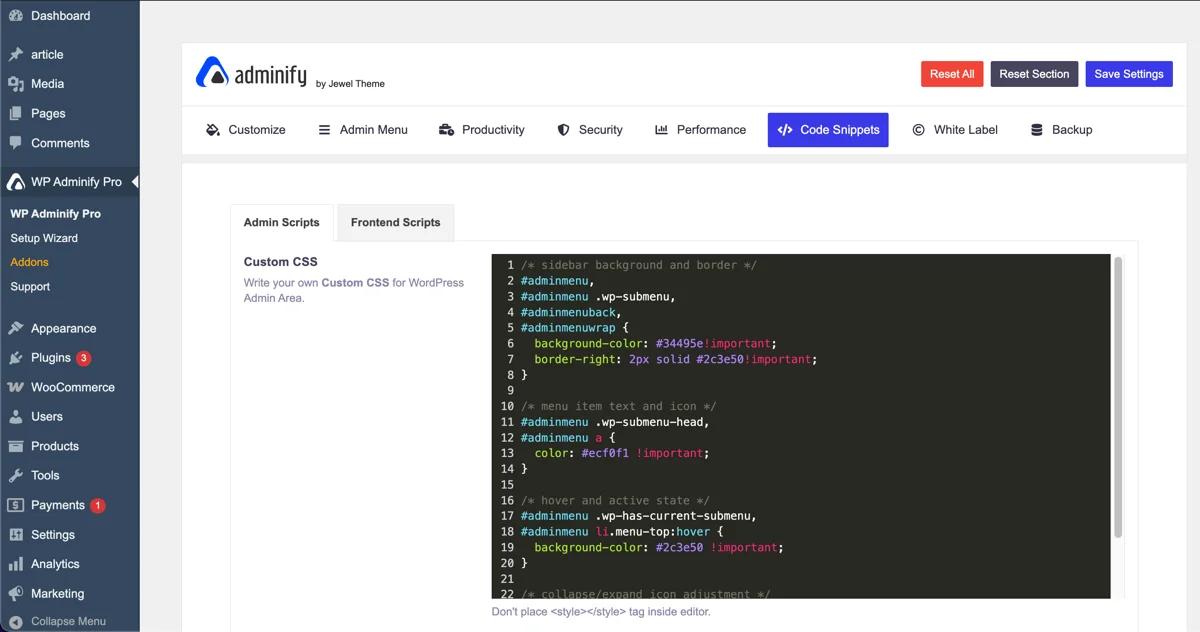
- Navigate to WP Adminify > Code Snippets.
- Click on the Admin Scripts tab.
Here, you can paste your custom CSS directly into the "Custom CSS" box. You can also add custom JavaScript here.
Why this method is great: Your CSS is stored in the database and loaded correctly on every admin page. It survives theme updates and is managed from a single, intuitive interface.
As you can see in this example, we simply added few line of CSS to change the color of the admin menu in the dashboard. Though it can be done easilly via the Admin Menu Editor by WP Adminify, I just show if you prefer the following custom methods.
Looking for more ways to customize? Check out our guide on How to customize WordPress Admin Bar based on user role.
Method 2: Using Your Theme's functions.php File (The Developer's Way)
For developers comfortable with code, adding CSS via your child theme's functions.php file is a common method.
function adminify_custom_admin_css() {
    echo '<style>
        /* Your Custom Admin CSS Goes Here */
        .postbox-header h2 {
            color: #966612 !important;
        }
    </style>';
}
add_action('admin_head', 'adminify_custom_admin_css');
Not recommended for beginners.
Before editing theme files, always ensure you have a solid backup strategy. Learn about WordPress backup best practices.
Method 3: Creating a Separate Admin CSS File (The Organized Way)
For larger projects, you can enqueue a separate stylesheet to keep your code organized.
function adminify_enqueue_custom_admin_style() {
    wp_enqueue_style( 'my-custom-admin-css', get_stylesheet_directory_uri() . '/admin-style.css', false, '1.0.0' );
}
add_action( 'admin_enqueue_scripts', 'adminify_enqueue_custom_admin_style' );
You would then create an admin-style.css file in your child theme's directory.
Method 4: Create a Plugin for Adding CSS in Dashboard
Begin by creating a new folder within your WordPress plugins directory. Name it something descriptive like 'Custom-Dashboard-CSS.' Inside this folder, create a main PHP file for your plugin. Let's call it custom-dashboard-css.php.
Add the following code to your custom-dashboard-css.php file. Feel free to customize the plugin head information like Name, Description, version, and Author. I kept the plugin head very simple because it's going to be a custom plugin for personal use.
<?php
/*
Plugin Name: Custom Dashboard CSS
Description: Inject custom CSS styles into the WordPress dashboard.
Version: 1.0
Author: Your Name
*/

function custom_dashboard_css() {
    echo '<style>/* Your custom CSS styles here */</style>';
}

// Hook into the admin_head action to inject CSS into the admin dashboard
add_action('admin_head', 'custom_dashboard_css');
?>
Here you don't have to create a custom CSS file. Take a look at line number 11 you can see /* Your custom CSS styles here */ comment. Just hit enter and start writing your CSS code under this comment.
For Example, I am sharing my custom-dashboard-css.php file in a Google Drive URL. Just download this, and you are ready to go.
Take a look at the following short mute video, and you will learn how the CSS code changed the Dashboard interface.
Must-Have WordPress Admin CSS Snippets (Copy & Paste Ready)
Now for the fun part! Here are some highly effective CSS snippets you can use immediately. If you're using WP Adminify, just paste these into the Admin Scripts box.
1. Change the Admin Menu Background Color
/* sidebar background and border */
#adminmenu,
#adminmenu .wp-submenu,
#adminmenuback,
#adminmenuwrap {
  background-color: #34495e!important;
  border-right: 2px solid #2c3e50!important;
}

/* menu item text and icon */
#adminmenu .wp-submenu-head,
#adminmenu a {
  color: #ecf0f1 !important;
}

/* hover and active state */
#adminmenu .wp-has-current-submenu,
#adminmenu li.menu-top:hover {
  background-color: #2c3e50 !important;
}

/* collapse/expand icon adjustment */
#adminmenu .wp-menu-arrow div {
  border-color: #ecf0f1 !important;
}
2. Hide Specific Dashboard Widgets for Cleanliness
/* Hide 'WordPress Events and News' */
#dashboard_primary { display: none; }

/* Hide 'Welcome to WordPress' */
#welcome-panel { display: none; }
3. Customize the Admin Bar (Top Bar)
/* change the top admin bar to a deep navy */
#wpadminbar {
  background: #2c3e50!important;
}

/* adjust link colors on hover */
#wpadminbar .ab-item,
#wpadminbar .ab-item:hover {
  color: #ecf0f1!important;
}

/* style search box in admin bar */
#wpadminbar #adminbarsearch {
  background: rgba(255,255,255,0.1)!important;
  border-radius: 3px;
}
4. Base Typography and Background
/* set a soft off-white background and darker text for better contrast */
body.wp-admin {
  background-color: #f5f7fa;
  color: #2c3e50;
}

/* apply a clean sans-serif font across admin */
body.wp-admin,
body.wp-admin * {
  font-family: "Segoe UI", Roboto, Helvetica, Arial, sans-serif !important;
}

/* style headings inside .wrap for consistency */
.wrap h1,
.wrapper h2 {
  color: #34495e;
  border-bottom: 2px solid #ecf0f1;
  padding-bottom: 8px;
}
5. Dashboard widget style and animation on hover
/* overall dashboard widget wrapping */
#dashboard-widgets-wrap {
  display: flex;
  flex-wrap: wrap;
  gap: 20px;
}


.postbox {
  background: #ffffff;
  border: 1px solid #e1e4e8;
  box-shadow: 0 1px 3px rgba(0,0,0,0.05);
  border-radius: 4px;

  /* Smooth transition for lift and shadow */
  transition: transform 0.3s ease-in-out, box-shadow 0.3s ease-in-out;
  will-change: transform, box-shadow;
}

.postbox:hover {
  transform: translateY(-5px);
  box-shadow: 0 4px 6px rgba(0,0,0,0.1);
}

/* widget header bar */
.postbox .hndle {
  background: #ecf0f1;
  padding: 10px;
  font-weight: 600;
  color: #2c3e50;
  border-bottom: 1px solid #d1d5da;
}

/* widget inner content padding */
.postbox .inside {
  padding: 15px;
}
6. Remove WordPress logo from login screen and admin footer
/* footer text tweak */
#wpfooter {
  background: #ecf0f1;
  color: #7f8c8d;
  border-top: 1px solid #d1d5da;
  padding: 10px;
}

/* remove WordPress logo from login screen and admin footer */
#wpfooter a[href*="wordpress.org"],
#wp-admin-bar-wp-logo {
  display: none !important;
}

/* style dashicons in menus or widgets */
.dashicons {
  color: #2980b9;
  font-size: 18px;
}
Adding Custom JavaScript to the Admin Area
Sometimes CSS isn't enough. What if you want to add interactivity, like showing a custom notice when a user interacts with a specific part of the dashboard?
Again, WP Adminify's Admin Scripts tab makes this incredibly easy. You can add JavaScript directly alongside your CSS.
Demo Use Case: Let's say you want to show a custom alert whenever a user clicks anywhere inside the "WooCommerce Setup" dashboard widget. This could be used for guidance or notifications.
Step 1: Identify the Element
Using browser tools (right-click -> Inspect), we can see the WooCommerce setup widget has a unique ID: #wc_admin_dashboard_setup.
Step 2: Write the JavaScript Code
Here is the code you can paste into the Admin Scripts box in WP Adminify:
document.addEventListener('DOMContentLoaded', function() {
  var wcWidget = document.getElementById('wc_admin_dashboard_setup');
  if (wcWidget) {
    wcWidget.addEventListener('click', function() {
      alert("Hello, this is an alert message!");
    });
  }
});
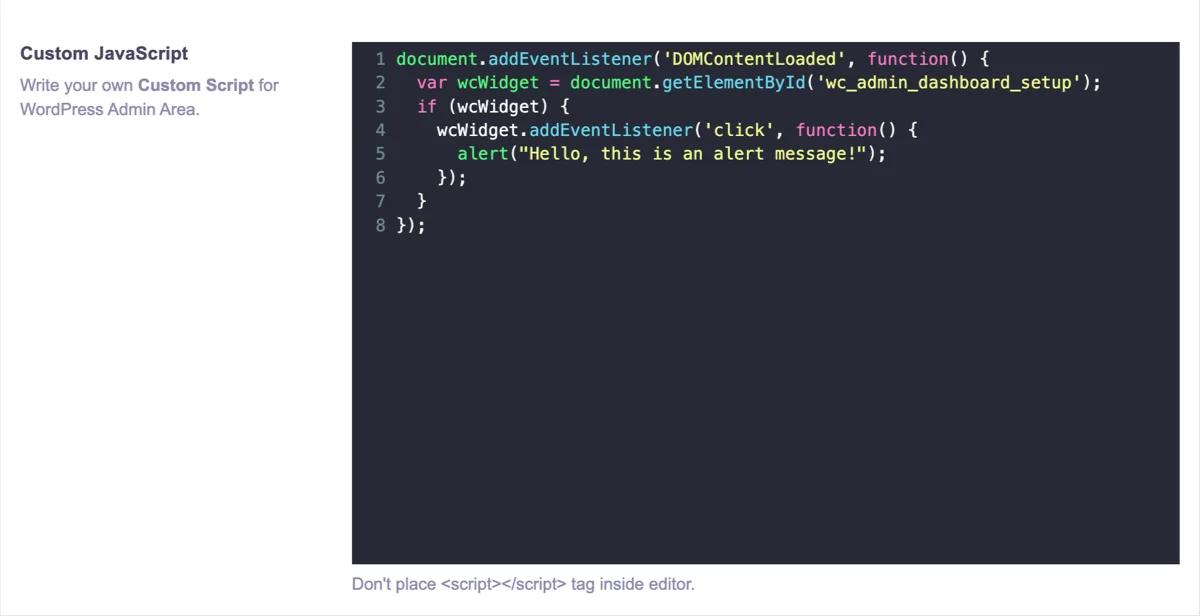
I have added the JS code inside WP Adminify code snippet option, here is the screenshot.
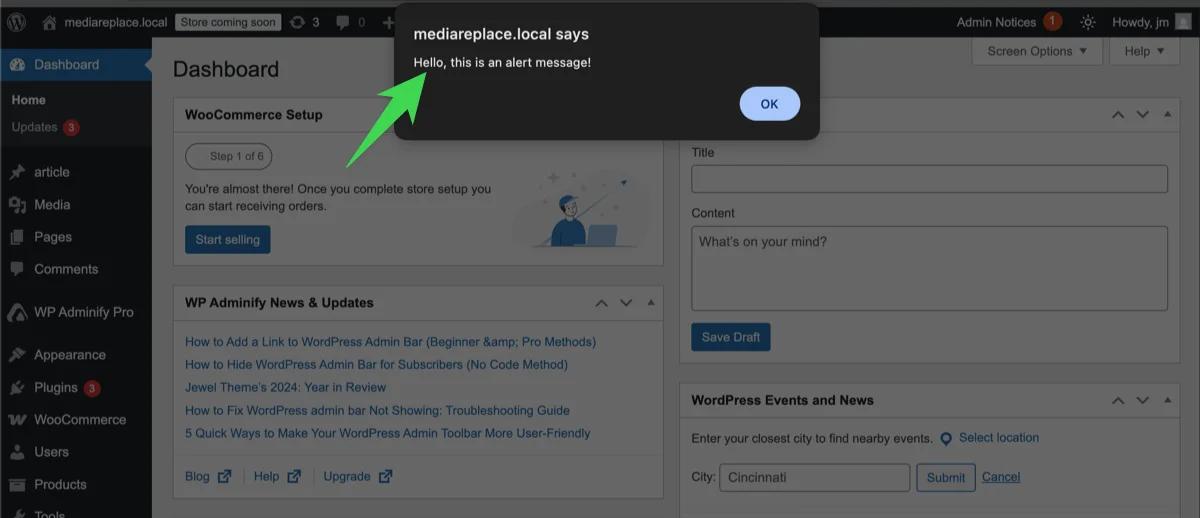
Now whenever someone click on the Woocommerce Dashboard widget, it will show an alert.
Related Reading
Custom CSS in WordPress Admin — FAQs
How do I add custom CSS to WordPress admin?
Use WP Adminify to add admin CSS without code, or add a snippet to functions.php using the admin_head action hook.
Will custom admin CSS affect the frontend?
No. CSS added via admin_head or WP Adminify only applies to the admin panel. Your frontend remains unaffected.
Can I change WordPress admin colors without a plugin?
WordPress has built-in color schemes under Users > Profile. For deeper customization, add CSS via functions.php or use WP Adminify for a visual editor.
Final words
For Everyone (Especially Freelancers & Agencies): Use the WP Adminify plugin. It not only offers the Custom CSS and JS, but also comes with dozens of other customization that a professional Dashboard needs.
If you are a developer and working on a Single Project. Then adding code to your functions.php or enqueuing a style sheet is perfect.
No matter which method you choose. Customization of WordPress Dashboard is a perfect way to create a more professional and enjoyable WordPress experience.
Ready to transform your WordPress dashboard? Explore all the features of WP Adminify today and start customizing without code!