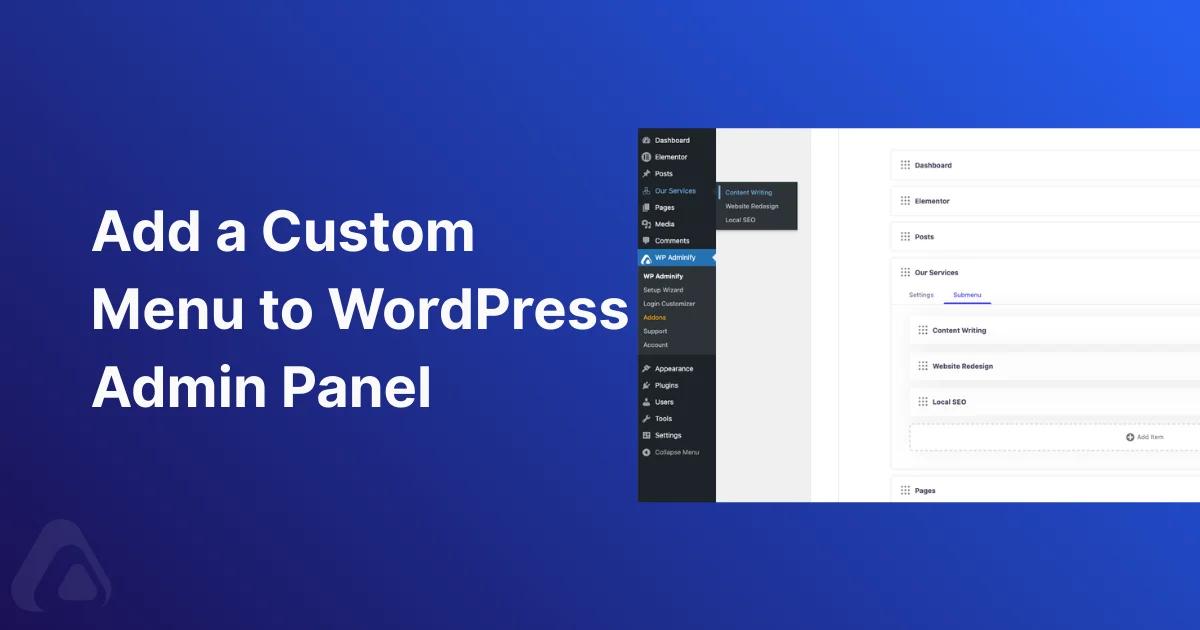

Ever feel like you're playing hide-and-seek with your own WordPress dashboard? You know that feature exists somewhere in the menu, but finding it means scrolling through 20+ items while your client waits impatiently. Adding a custom menu to your WordPress admin dashboard isn't just about organization, it's about reclaiming hours of wasted time and eliminating that daily frustration of menu chaos.
This comprehensive guide covers both plugin-based and code-based methods to add custom menus to your WordPress admin panel, along with best practices, troubleshooting tips, and real-world use cases.
Adding a new menu vs. editing existing ones: this guide covers adding a brand-new custom menu or page to the sidebar. If you instead want to reorder, rename, or hide the menu items WordPress and your plugins already created, see our guide on how to use the WordPress admin menu editor, or how to remove admin menu items you do not need.
What is a WordPress Admin Menu?
The WordPress admin menu is the vertical navigation bar on the left side of your dashboard that provides access to all administrative functions. By default, it includes links to Posts, Pages, Media, Comments, Appearance, Plugins, Users, and Settings.
As your website grows and you install more plugins, the admin menu can become cluttered with dozens of items, making it difficult to find what you need quickly.
Key Components of Admin Menus
- Top-level menus: Main menu items (Posts, Pages, Settings)
- Submenus: Nested items under parent menus
- Menu separators: Visual dividers that group related items
- Custom icons: Visual identifiers using Dashicons or custom images
- Capabilities: Permission levels that control menu visibility
Why Create Custom Admin Menus?
Benefits of Custom Admin Menus
- Improved workflow efficiency: Quick access to frequently used pages reduces navigation time
- Better organization: Group related functionality under logical menu structures
- Client-friendly dashboards: Hide technical options from clients while maintaining access for developers
- Role-based navigation: Display different menu items based on user capabilities
- External tool integration: Add links to external platforms like analytics, CRM, or project management tools
- Reduced cognitive load: A cleaner dashboard helps users focus on essential tasks
Common Use Cases
- Agency websites: Create client-specific dashboards with only relevant features
- Membership sites: Provide role-based menu access for different member levels
- Multi-author blogs: Customize menus based on contributor, editor, and admin roles
- E-commerce stores: Group product management, orders, and shipping under custom menus
- White-label solutions: Rebrand admin menus with custom icons and labels
Method 1: Add Custom Admin Menu Using a Plugin
Using a plugin is the easiest and most beginner-friendly approach, requiring no coding knowledge.
Recommended Plugin: WP Adminify Admin Menu Editor
WP Adminify's Admin Menu Editor offers a visual interface for creating and managing custom admin menus with drag-and-drop functionality.
Step-by-Step Instructions
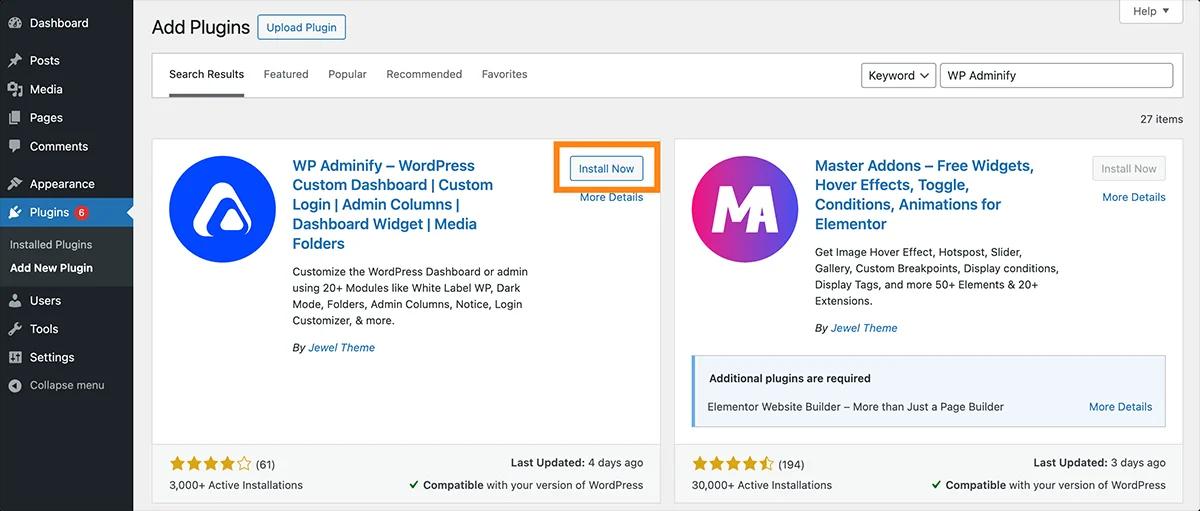
- Go to Plugins > Add New in your WordPress dashboard
- Search for "WP Adminify"
- Click Install Now, then Activate
Step 2: Access Menu Editor
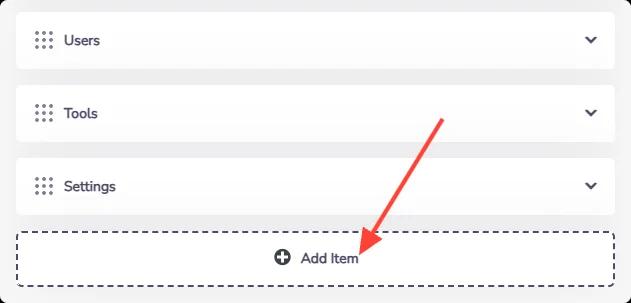
Navigate to WP Adminify > Menu Editor in your dashboard
Click the Add Item button to create a new menu
Step 3: Configure Your Custom Menu
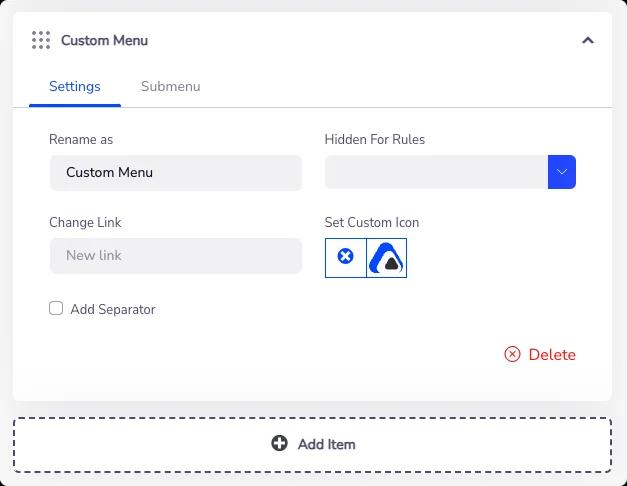
The menu editor interface displays all configuration options:
- Visibility Rules: Hide menus from specific users or roles
- Menu Title: Enter a descriptive name for your menu item
- Menu Link: Specify the destination URL (internal WordPress page or external link)
- Capability: Set user role requirements (manage_options, edit_posts, etc.)
- Icon Selection: Choose from Dashicons, Simple Line Icons, Themify Icons, or upload custom icons
Step 4: Add Menu Icons
WP Adminify supports multiple icon libraries:
- Dashicons (WordPress native icons)
- Simple Line Icons
- Themify Icons
- Icomoon Icons
- Custom uploaded icons (automatically resized)

Step 5: Add Separators
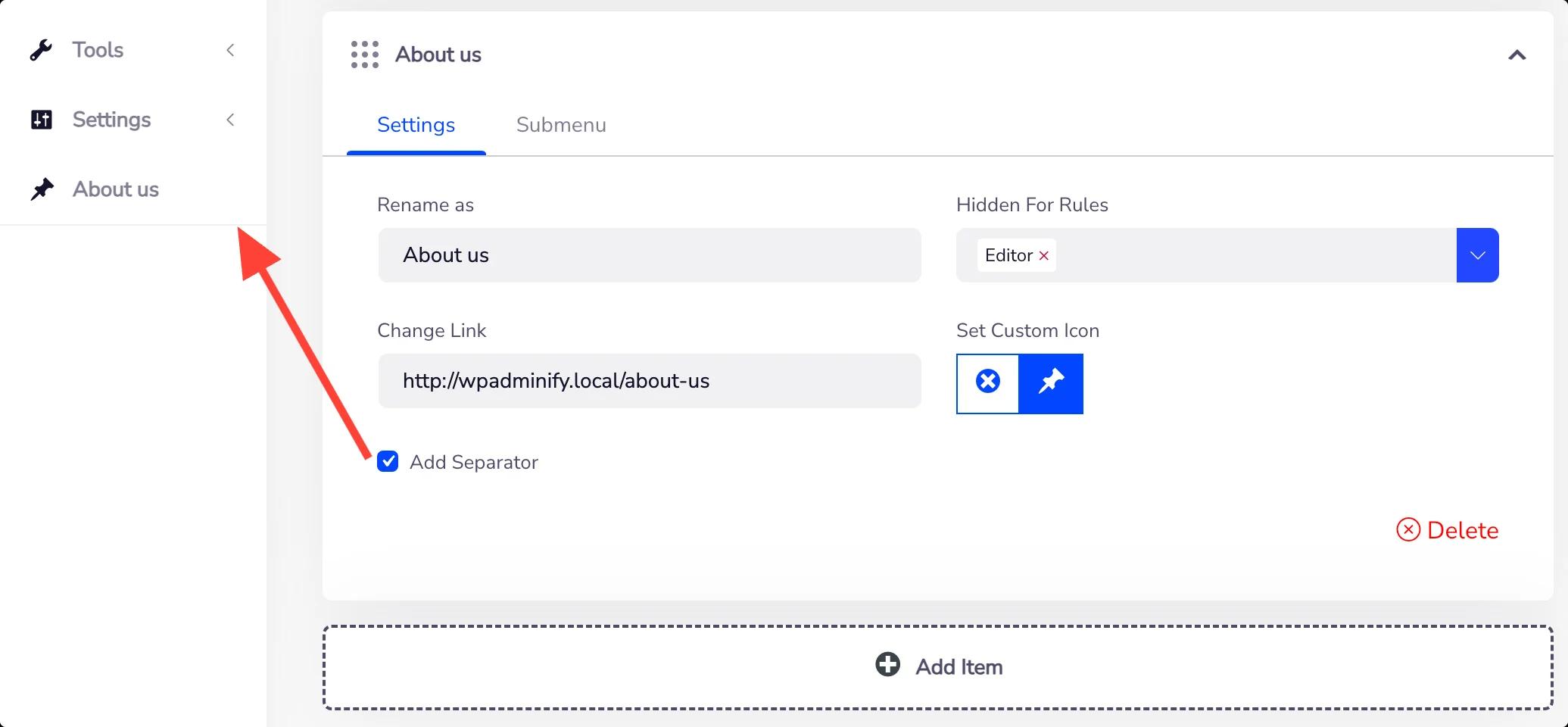
To visually group menu items:
- Enable the Add Separator checkbox
- Position the separator above or below specific menus
- Save changes
Step 6: Create Submenus
To add submenu items under any parent menu:
- Click the Add Submenu option
- Configure submenu title and link
- Note: Custom icons are not available for submenus (WordPress limitation)
- Create unlimited nested submenus as needed
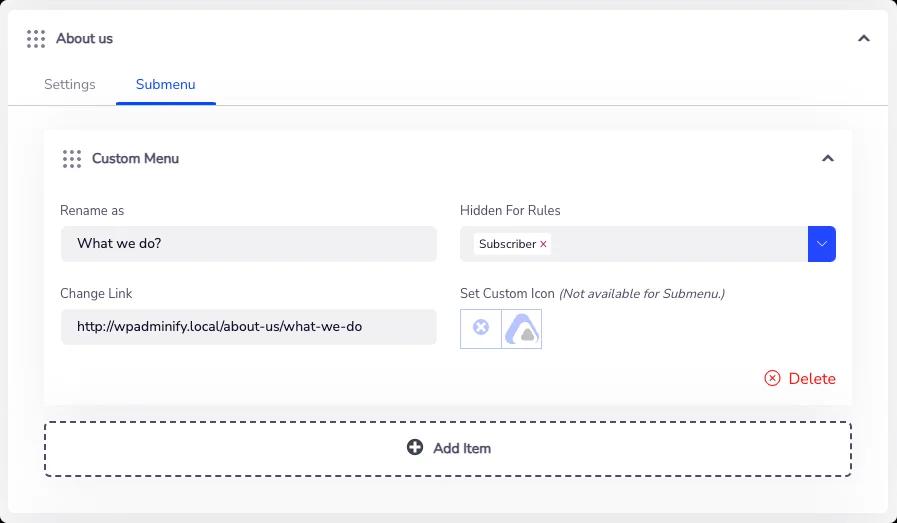
Step 7: Save and Test
Click Save Changes and navigate your dashboard to verify the new menu appears correctly with proper permissions.
Advanced Plugin Features
- Conditional display: Show menus only on specific dates or conditions
- Menu duplication: Copy existing menus to create variations
- Import/export: Transfer menu configurations between sites
- Menu item hiding: Temporarily disable menus without deleting
- Custom CSS classes: Add styling hooks for advanced customization
Method 2: Add Custom Admin Menu Using Code
For developers who prefer manual control or want to avoid plugin dependencies, WordPress provides built-in functions for custom menu creation.
Prerequisites
- Basic PHP knowledge
- Access to your theme's functions.php file or a custom plugin
- Understanding of WordPress capabilities and user roles
Step 1: Access functions.php
- Go to Appearance > Theme File Editor
- Select Theme Functions (functions.php) from the right sidebar
- Alternatively, access via FTP or cPanel File Manager
Safety Tip: Always use a child theme or create a custom plugin to prevent losing changes during theme updates.
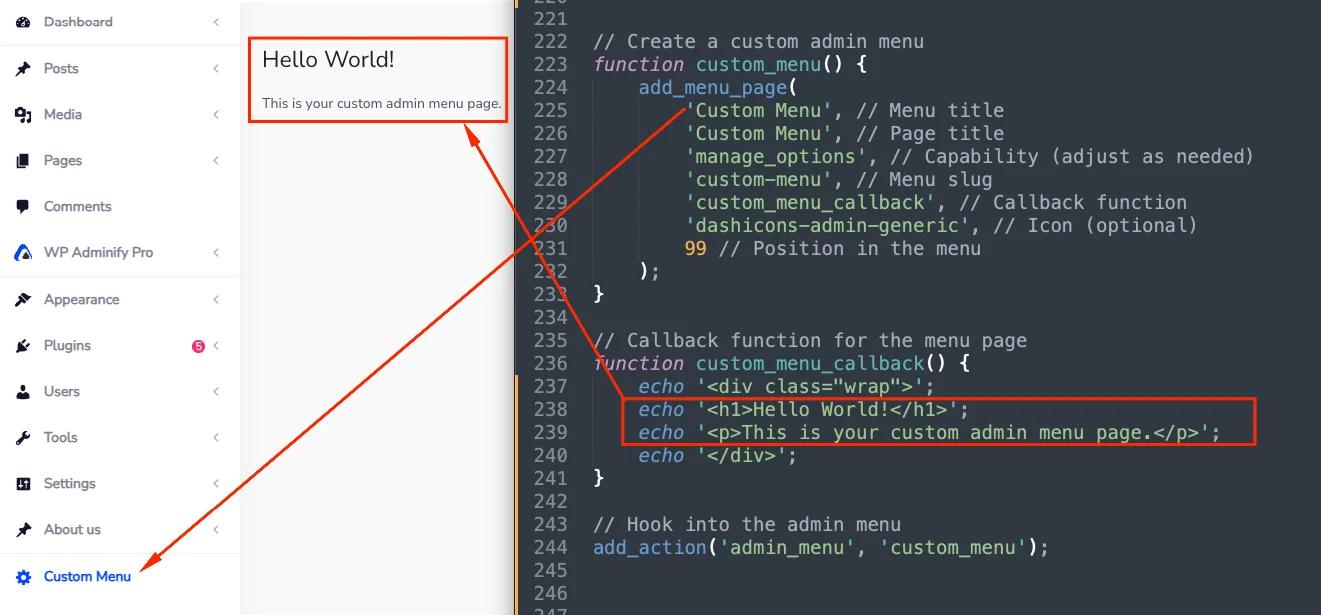
Step 2: Add Basic Custom Menu Code
Paste this code into functions.php:
/**
 * Create a custom admin menu
 */
function wpb_custom_admin_menu() {
    add_menu_page(
        'My Custom Page',           // Page title
        'Custom Menu',              // Menu title
        'manage_options',           // Capability
        'my-custom-menu',           // Menu slug
        'wpb_custom_menu_callback', // Callback function
        'dashicons-admin-generic',  // Icon
        25                          // Position
    );
}
add_action('admin_menu', 'wpb_custom_admin_menu');

/**
 * Callback function to display menu content
 */
function wpb_custom_menu_callback() {
    ?>
    <div class="wrap">
        <h1><?php echo esc_html(get_admin_page_title()); ?></h1>
        <p>Welcome to your custom admin page.</p>
        <!-- Add your custom content here -->
    </div>
    <?php
}
Step 3: Add Submenus
To create submenu items under your custom menu:
function wpb_custom_admin_submenu() {
    add_submenu_page(
        'my-custom-menu',              // Parent menu slug
        'Submenu Page Title',          // Page title
        'Submenu Item',                // Menu title
        'manage_options',              // Capability
        'my-custom-submenu',           // Menu slug
        'wpb_custom_submenu_callback'  // Callback function
    );
}
add_action('admin_menu', 'wpb_custom_admin_submenu');

function wpb_custom_submenu_callback() {
    echo '<div class="wrap"><h1>Submenu Content</h1></div>';
}
Understanding Function Parameters
- $page_title: Browser tab title and page heading
- $menu_title: Text displayed in admin menu
- $capability: Required user capability (manage_options, edit_posts, read, etc.)
- $menu_slug: Unique identifier for the menu (use lowercase with hyphens)
- $callback: Function that renders the page content
- $icon_url: Dashicon class, image URL, or base64 encoded SVG
- $position: Menu position (5=below Posts, 25=below Comments, 60=below Settings)
Available Dashicons
WordPress includes 300+ Dashicons. Popular options:
dashicons-admin-genericdashicons-admin-settingsdashicons-admin-toolsdashicons-admin-usersdashicons-chart-bardashicons-analytics
View all icons at: developer.wordpress.org/resource/dashicons
Common Menu Position Values
- 2 = Dashboard
- 5 = Posts
- 10 = Media
- 15 = Links
- 20 = Pages
- 25 = Comments
- 60 = Appearance
- 65 = Plugins
- 70 = Users
- 75 = Tools
- 80 = Settings
- 99 = Bottom of menu
Advanced Customization Techniques
Role-Based Menu Display
Show menus only to specific user roles:
function wpb_role_based_menu() {
    $current_user = wp_get_current_user();

    if (in_array('administrator', $current_user->roles)) {
        add_menu_page(
            'Admin Only Page',
            'Admin Menu',
            'manage_options',
            'admin-only-menu',
            'wpb_admin_menu_callback',
            'dashicons-shield-alt',
            30
        );
    }
}
add_action('admin_menu', 'wpb_role_based_menu');
External Link Menus
Create menu items that link to external tools:
function wpb_external_link_menu() {
    add_menu_page(
        'Analytics Dashboard',
        'Analytics',
        'manage_options',
        'https://analytics.google.com',
        '',
        'dashicons-chart-area',
        35
    );
}
add_action('admin_menu', 'wpb_external_link_menu');
Add Menu Separators
Create visual separators between menu groups:
function wpb_add_menu_separator($position) {
    global $menu;
    $menu[$position] = array(
        0 => '',
        1 => 'read',
        2 => 'separator' . $position,
        3 => '',
        4 => 'wp-menu-separator'
    );
}
add_action('admin_menu', function() {
    wpb_add_menu_separator(26);
});
Menu Disappears After Theme Update
Solution: Move custom menu code from theme functions.php to a child theme or create a custom plugin.
Security Considerations
- Capability checks: Always verify user permissions using current_user_can()
- Nonce verification: Add nonce fields to forms on custom menu pages
- Data sanitization: Sanitize all user inputs with sanitize_text_field(), wp_kses(), etc.
- Output escaping: Use esc_html(), esc_url(), esc_attr() when displaying data
- Direct file access prevention: Add
if (!defined('ABSPATH')) exit;at top of files
Performance Optimization
Lazy load menu content: Don't execute callback code until page is viewed
Minimize database queries: Cache menu data when possible
Avoid heavy operations in callbacks: Load resources only when menu page is accessed
Use transients: Store expensive computations temporarily
Related Reading
Is this the admin menu or the site navigation menu?
Worth settling first, because WordPress uses the word "menu" for two unrelated things. The admin menu is the dark sidebar you see inside wp-admin, holding Posts, Media, Plugins and so on. That is what this guide covers. The navigation menu is the one visitors click on the front of your site, and you build that under Appearance then Menus. If you came here wanting the visitor-facing one, our guide to creating a custom navigation menu in WordPress is the right page.
How do you add a menu to the network admin on multisite?
Hooking admin_menu only reaches individual sites. The network dashboard has its own hook, network_admin_menu, so register there instead when the page should appear for the network administrator. The callback and add_menu_page() arguments are identical, only the hook changes.
Two things catch people out. Use the manage_network_options capability rather than manage_options, or the item is invisible to everyone including you. And if you want the same menu in both places, register it on both hooks: adding it once on admin_menu will not surface it in the network admin.
How do you rename an existing admin menu item?
Renaming is not the same as adding. Core items like Posts get their label from WordPress itself, so you are overriding a value rather than creating one. In code you reach into the global $menu array and change the label at that item's index, which works but breaks quietly whenever the index shifts after a plugin adds its own item.
That fragility is why relabelling is usually better done visually. The admin menu editor lets you rename an item, swap its icon and drag it to a new position without touching an index that may move next week.
Why is the admin sidebar collapsed, and how do you expand it?
If your menu shows only icons, it is collapsed rather than broken. Click Collapse menu at the bottom of the sidebar to toggle it back. WordPress stores that state per user, so expanding it for your account does not change what your client sees, and the sidebar also collapses on its own at narrow screen widths.
If it stays collapsed after toggling, the usual culprits are a browser cache holding the old user setting or a plugin forcing the state. Hard-refresh first, then test with plugins disabled.
WordPress Admin Menu FAQs
Can I add custom menus without affecting other users?
Yes, use capability checks and role-based conditions to display menus only to specific users.
Will custom menus survive theme updates?
Only if added via child theme, custom plugin, or site-specific plugin. Avoid editing parent theme files directly.
Can I reorder existing WordPress menus?
Yes, using plugins like WP Adminify or by manipulating the global $menu array with code.
How many custom menus can I add?
There's no hard limit, but too many menus create usability issues. Focus on consolidation and organization.
Can I add menus that link to external websites?
Yes, specify the external URL as the menu slug parameter in add_menu_page().
Do custom menus work with multisite?
Yes, use the network_admin_menu hook instead of admin_menu for network admin menus.
Can I hide default WordPress menus?
Yes, using remove_menu_page() function or menu editor plugins.
Conclusion
Creating custom admin menus in WordPress significantly improves dashboard organization and user experience. For non-developers, plugins like WP Adminify provide intuitive interfaces for menu management without coding. Developers who prefer full control can use WordPress's add_menu_page() and add_submenu_page() functions to create fully customized solutions.
Start by identifying which menus you use most frequently, plan your menu structure logically, and implement either the plugin or code method based on your technical comfort level. Regular testing with different user roles ensures your custom menus provide the right access to the right people.
But, if you’re not into coding, WP Adminify will help you with that. You can create your custom menus without any trouble.